Two Weeks in Saudi Arabia: The Ultimate Itinerary
Day-by-day two-week Saudi Arabia itinerary for 2026: Riyadh, AlUla, Jeddah and Asir with verified costs (eVisa SAR 535, Hegra from SAR 95), booking tips and advisory guidance.
Key Takeaways
- The route: Riyadh (Days 1–4), AlUla (Days 5–8), Jeddah (Days 9–11) and the Asir highlands (Days 12–14), linked by three domestic flights of about 1–1.5 hours each.
- Two real bottlenecks: Hegra is visitable only on pre-booked Experience AlUla tours (from SAR 95), and AlUla hotels sell out months ahead in season — book both first.
- Diriyah's At-Turaif is an evening site (17:00–24:00, last entry 23:00), and the National Museum in Riyadh is free but closed Sundays — plan those days around it.
- Visa: the eVisa covers citizens of 66 countries at SAR 535 online (insurance included), valid one year, multiple entry, 90 days per visit.
- The Asir finale sits under a US do-not-travel advisory (Abha and Khamis Mushayt) in 2026 — check your government's guidance, or swap Days 12–14 for Taif or the Umluj coast.
- Best travel window is October to April; anchor costs: Riyadh Metro 2-hour pass SAR 4, Haramain rail from about SAR 150, riyal pegged at 3.75/USD.
Two Weeks in Saudi Arabia: The 2026 Itinerary
Fourteen days is the sweet spot for a first Saudi trip: enough time for the capital, the Nabataean tombs of AlUla, the coral-house old town of Jeddah and a finale in the green Asir highlands — without the daily pack-and-move grind of a shorter route. This itinerary runs Riyadh (Days 1–4), AlUla (Days 5–8), Jeddah (Days 9–11) and Asir (Days 12–14), connected by three short domestic flights.
One honesty note before the day-by-day: the Asir leg sits in Saudi Arabia's far southwest, where several governments currently advise against travel. We cover what that means — and a straightforward alternative ending — in the Asir section below, so you can decide with open eyes. If two weeks is more than you have, our one-week Golden Triangle route compresses the first three stops into seven days.
Essential Info for 2026
- Visa: the Saudi eVisa is open to citizens of 66 countries and costs SAR 535 online (about USD 143), including mandatory medical insurance. It is valid one year, multiple entry, up to 90 days per visit. Visa on arrival at major airports runs about SAR 480 for the same nationalities.
- Currency: Saudi Riyal, pegged at 3.75 to the US dollar. Cards and Apple Pay work almost everywhere; keep small cash for souqs.
- Best months: October to April, with daytime temperatures roughly 15–30°C. Summer regularly exceeds 40°C inland.
- Getting around: domestic flights link every stop on this route in about 1–1.5 hours each. In Riyadh, the metro's 2-hour pass costs SAR 4; Uber and Careem operate in all major cities. The Haramain high-speed rail connects Jeddah with Madinah from about SAR 150.
- Dress: modest clothing is the norm — shoulders and knees covered is a sensible baseline. The abaya has not been required for foreign women since 2019.
- Alcohol: prohibited throughout the country, for tourists too. Plan around excellent coffee instead.
- Safety: the main tourist regions on this route — Riyadh, AlUla, Jeddah — are generally very safe for visitors. Note that the US State Department rates Saudi Arabia at Level 3 overall in 2026 and advises against travel to the far southwest, which affects Days 12–14 (details in the Asir section).
Days 1–4: Riyadh
Land at King Khalid International Airport and give yourself four days in the capital — a city rebuilding itself at speed, where restored mud-brick districts sit twenty minutes from glass towers. The metro (SAR 4 for a 2-hour pass) plus ride-hailing covers everything below.
- Day 1 — Arrival and the skyline. Settle in, then head up the Kingdom Centre Tower sky bridge for a first look at the city grid stretching into the desert. Ticket prices have changed repeatedly since a 2026 management change, so check at the counter. Dinner in the King Abdullah Financial District, whose towers and walkways are a destination in themselves.
- Day 2 — Old Riyadh. Start at Masmak Fort (free), the mud-brick citadel at the heart of the Saudi founding story, then haggle through Souq Al Zal for carpets and oud. In the afternoon, the National Museum of Saudi Arabia — entry is free, and it is closed on Sundays, so slot it accordingly. Finish with kabsa at a traditional restaurant.
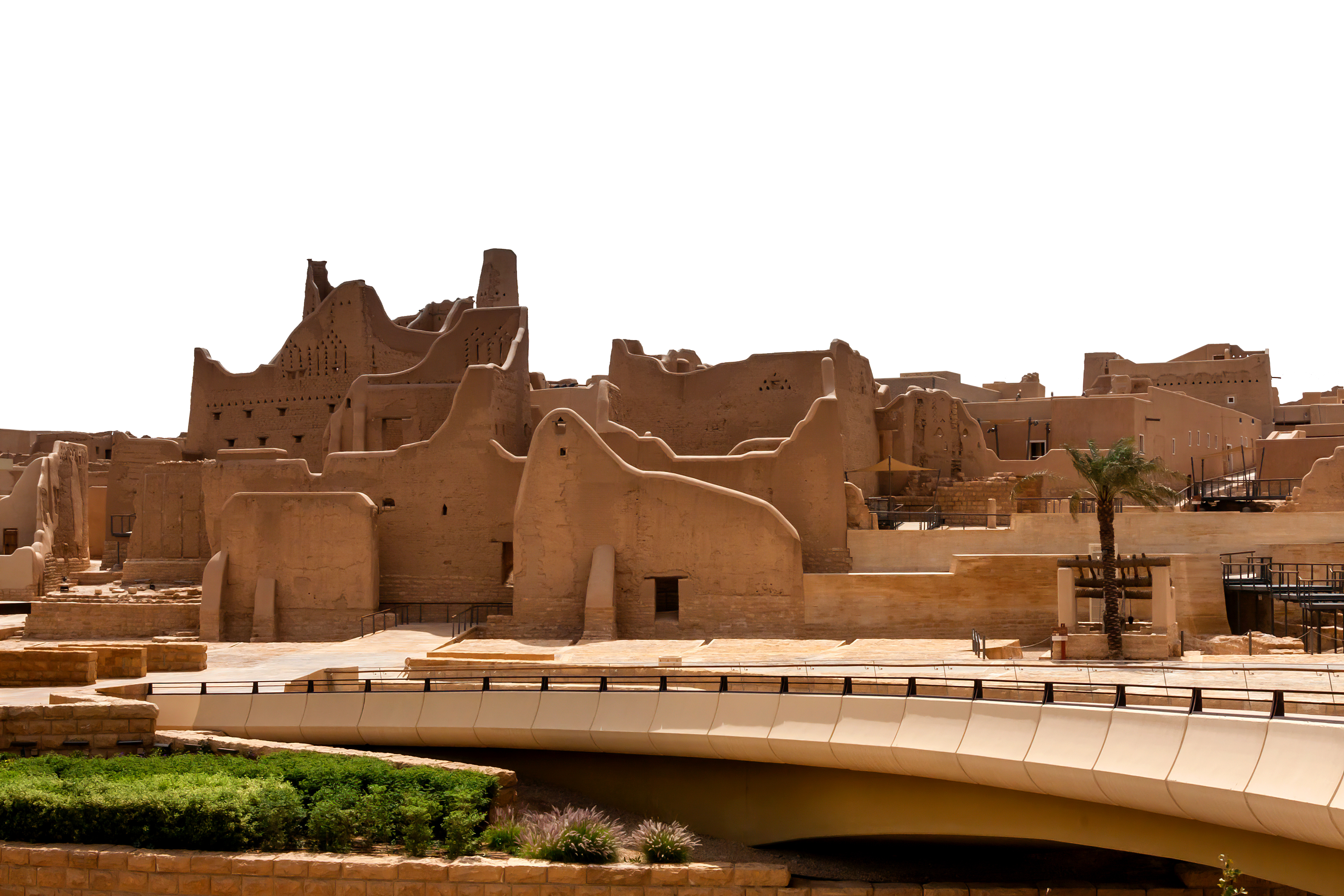
- Day 3 — Slow morning, Diriyah evening. Diriyah's At-Turaif district — the UNESCO-listed birthplace of the Saudi state — is an evening site, open 17:00–24:00 with last entry at 23:00. Spend the day easy (galleries, parks, or the spa), then arrive at Bujairi Terrace for sunset, dinner overlooking the wadi, and the illuminated mud-brick city after dark. The Diriyah Pass has run roughly SAR 50–100 with under-12s free, and access has been free during parts of 2026 — check diriyah.sa for current arrangements.
- Day 4 — Edge of the World, fly to AlUla. A morning 4x4 excursion to Jabal Fihrayn, the escarpment north of the city where the plateau drops away beneath your feet. Go with a guided tour — expect roughly SAR 800–1,500 for a private vehicle — and be back by mid-afternoon for the evening flight to AlUla (about 1.5 hours).
Days 5–8: AlUla
AlUla is the trip's centrepiece: a valley of sandstone outcrops holding Hegra, Saudi Arabia's first UNESCO World Heritage Site, plus a restored old town and some of the darkest night skies you will find. Book everything here ahead — Hegra runs on timed, guided entry only, and the better hotels sell out months in advance in season. Our AlUla guide covers the valley in full depth.
- Day 5 — Hegra, Jabal Ikmah, Dadan. The Nabataeans carved more than 100 monumental tombs into Hegra's outcrops two millennia ago, and the site is visitable only on pre-booked tours through Experience AlUla — coach tours start from SAR 95, with premium 4x4 options from SAR 1,000 per vehicle. Pair it with Jabal Ikmah, the canyon of ancient inscriptions, and Dadan, capital of the kingdoms that preceded the Nabataeans.
- Day 6 — Old Town and Elephant Rock. Morning in AlUla Old Town's restored mud-brick lanes, afternoon rest, then Elephant Rock for sunset — the valley's most photographed formation, with sunken seating pits and coffee among the sand. Stay out for stargazing; light pollution here is close to zero.
- Day 7 — Canyons or culture. Hike one of the guided wadi trails in the morning, or see what is on at Maraya — the mirrored concert hall that reflects the desert around it hosts exhibitions and events through the cooler months. AlUla's farm-to-table restaurants have become a reason to visit in their own right.
- Day 8 — Oasis, fly to Jeddah. Walk the oasis path among the date palms before the heat builds, then fly to Jeddah (about 1.5 hours).
Days 9–11: Jeddah
Jeddah is the Red Sea in city form — a port that spent centuries receiving pilgrims and merchants, which shows in its food, its dialect and above all in Al Balad, the UNESCO-listed old town of coral-stone tower houses. See our full Jeddah guide for more. One important point of respect and law: Makkah, an hour down the road, is closed to non-Muslims entirely, as is the central sanctuary of Madinah — this route does not include them, and non-Muslim travellers should not attempt to visit.
- Day 9 — Al Balad. Lose the morning in the old town's alleys: Nassif House, where Abdulaziz Ibn Saud once held court; roshan balconies in carved teak; Souq Al Alawi for spices and textiles. Al Balad is at its best in the golden hour, when the coral walls glow. Fresh Red Sea fish for dinner, grilled at the fish market restaurants.
- Day 10 — Corniche and art. Walk the waterfront Corniche past its open-air sculptures, watch King Fahd's Fountain fire seawater hundreds of metres into the sky, and visit the Al Rahmah Mosque, built out over the water. In the afternoon, Jeddah's serious gallery scene — Athr Gallery is the anchor — or simply swim at one of the beach clubs north of the city.
- Day 11 — Last morning, fly to Abha. A final souq run or a museum stop, then the one-hour flight to Abha in the Asir highlands.
Days 12–14: The Asir Mountains — Read This First
The advisory situation, plainly: Abha and Khamis Mushayt are on the US State Department's do-not-travel list within its 2026 Saudi Arabia advisory, owing to the risk of drone and missile attacks in areas near the Yemen border. Other governments carry similar regional warnings, and many travel insurance policies will not cover areas under a do-not-travel advisory. Check your own government's current guidance and your policy before locking in this leg. If you would rather keep the trip entirely inside the advisory-free zone, swap Days 12–14 for Taif and the Hejaz mountains above Jeddah, or head up the coast to the beaches of Umluj and Al Wajh — both make a satisfying final act without the caveat.
If you do continue, the reward is a Saudi Arabia most visitors never see: juniper forests, terraced farms, cool air at 2,200 metres and the distinct stone-and-quartz architecture of the highlands.
- Day 12 — Abha. Ride the cable car over the escarpment (ticket prices vary by route — buy on site), circle Abha Dam Lake, and see Shada Palace, the whitewashed tower house in the city centre, if it is open when you visit. Asiri dinner of areekah and mountain honey.
- Day 13 — Rijal Almaa. Day trip to the fortress village of Rijal Almaa (about 1.5 hours' drive), long on the UNESCO tentative list: multi-storey stone towers trimmed with white quartz, a village museum, and — if you are lucky — the flower men of Asir with their herb-and-marigold crowns. The switchback drive down the escarpment is half the experience.
- Day 14 — Habala and home. Cable car down to Habala, the "hanging village" built into a cliff ledge, or browse Abha's Tuesday Market for honey and juniper crafts, then fly out via Riyadh or Jeddah.
Planning Notes for 2026
- Book early where it matters: Hegra tours and AlUla hotels are the two genuine bottlenecks — secure both before booking anything else. Domestic flights are cheapest several weeks out.
- Prayer times: some shops and sights pause briefly around prayer, most noticeably at midday Friday. Build slack into your mornings.
- Photography: ask before photographing people, especially women, and keep the camera down at security-related sites.
- Connectivity: a tourist eSIM activated on arrival is the simplest option and covers every stop on this route.
- Water and sun: even in winter the sun is strong at altitude and in the desert — carry water everywhere, especially at Hegra and Edge of the World.
- Emergency numbers: police 999, ambulance 997, fire 998.
Route logistics aside, the two-week format leaves room for the thing that actually stays with visitors: unhurried evenings — coffee poured in a Najdi courtyard, the calls to prayer overlapping across Al Balad's rooftops, a sky over AlUla with more stars than you have seen in years. Travel the route at that pace and the Kingdom does the rest.
Related Reading
- One Week in Saudi Arabia: The Golden Triangle Itinerary
- The 10-Day Family Itinerary
- Top Adventure Tours in Saudi Arabia
Ready to turn these 14 days into a booked route?
Feed your dates and pace into our Trip Planner and it will adapt this route to your season, budget and interests — then shortlist where to sleep at each stop with our hotel guide. AlUla sells out first; start there.
Frequently Asked Questions
- What is the best time of year for this two-week itinerary?
- October to April, when daytime temperatures run roughly 15–30°C across the route. Summer regularly exceeds 40°C in Riyadh and AlUla. If your dates overlap Ramadan, expect daytime restaurant closures and adjusted opening hours — the evenings, in exchange, are lively.
- How much should I budget for two weeks in Saudi Arabia?
- Mid-range travellers typically spend roughly SAR 5,500–9,500 (about USD 1,500–2,500) excluding international flights: hotels around SAR 200–400 a night, meals SAR 20–60, plus domestic flights, Hegra tours and a 4x4 excursion. AlUla is the priciest stop; Riyadh and Jeddah offer the widest budget spread.
- How do I get between the stops on this route?
- By air: Riyadh–AlUla, AlUla–Jeddah and Jeddah–Abha each take about 1–1.5 hours, and flights are far quicker than the long desert drives between these regions. Within cities, use the Riyadh Metro (2-hour pass SAR 4), Uber or Careem.
- Is the Asir portion of this itinerary safe?
- Check before you book: the US State Department lists Abha and Khamis Mushayt as do-not-travel areas in its 2026 Saudi Arabia advisory due to drone and missile risk near the Yemen border, and many insurers exclude such areas. A common workaround is ending the trip in Taif or on the Umluj coast instead.
- Can non-Muslims visit Makkah on this itinerary?
- No. Makkah is closed to non-Muslims entirely, and the central sanctuary area of Madinah is likewise restricted. This route deliberately does not include them — Jeddah, the historic gateway city, is fully open to all visitors.
- Should I book accommodation in advance?
- Yes — AlUla months ahead (it has limited rooms and sells out in season), Riyadh and Jeddah a few weeks ahead for the October–March peak. Book Hegra tour slots before finalising your AlUla nights, since entry is by pre-booked tour only.