One Week in Saudi Arabia: The Complete Experience
Riyadh 2 nights, AlUla 2, Jeddah 2, flying the two long legs. Day-by-day plan with Hegra tours from SAR 95 and a realistic daily budget.
Key Takeaways
- A workable seven-day route is Riyadh (2 nights), AlUla (2 nights), Jeddah (2 nights), with both internal legs flown - Riyadh to AlUla is about 1,000 km and driving it costs a full day.
- Makkah is closed to non-Muslims - the whole city, not only the Grand Mosque. Madinah city is open to all visitors, but the Haram zone around the Prophet's Mosque is not.
- Hegra can only be visited on a guided tour, from SAR 95 per person for about two hours, booked in advance on experiencealula.com - winter slots sell out weeks ahead.
- The tourist eVisa costs SAR 535 (SAR 395 visa plus SAR 140 mandatory insurance), covers 66 nationalities, and is valid one year for multiple entries of up to 90 days each, 180 days per year.
- Diriyah's At-Turaif costs roughly SAR 50-100 per person and the fee is redeemable against food at Bujairi Terrace; children twelve and under enter free.
- October to March is the workable window - Riyadh and AlUla pass 40 C from May to September, and AlUla's sites are open-air.
What this week covers, and what it leaves out
Seven days is enough for three places in Saudi Arabia, not five. This route gives you two nights in Riyadh, two in AlUla and two in Jeddah, with both internal legs flown rather than driven. Riyadh to AlUla is roughly 1,000 km and Jeddah to Riyadh about 850 km; driving either one costs a full day you do not have on a week-long trip.
The week deliberately leaves out Makkah and Madinah. Makkah is closed to non-Muslims — the entire city, not only the Grand Mosque, and checkpoints on the approach roads enforce it. Madinah city itself is open to all visitors, but the Haram zone around the Prophet’s Mosque is not. If you are travelling for Umrah, that is a separate trip on a different visa track and does not belong inside a sightseeing week.
Before you commit, check your own government’s current travel advice for Saudi Arabia, in particular for the southern regions near the Yemen border. None of the three stops on this route are in that area, but the advisory level for the country as a whole is worth reading before you book flights.
Before you book
- Visa. Citizens of 66 countries can apply for the tourist eVisa online at visa.visitsaudi.com. The fee is SAR 535, made up of SAR 395 for the visa itself and SAR 140 of mandatory medical insurance. It is a one-year, multiple-entry visa allowing up to 90 days per entry. Most applications are decided within 24 to 72 hours. Some nationalities can also be issued a visa at the airport — the conditions are set out in our visa on arrival guide.
- Money. The Saudi riyal is pegged at 3.75 to the US dollar, so SAR 100 is about USD 27. Cards work almost everywhere, including taxis; keep a little cash for souqs, small cafes and parking machines.
- When to go. October to March is the workable window for this itinerary. Riyadh and AlUla sit well above 40 °C from May to September, and AlUla’s open-air sites are difficult in that heat. Desert nights in AlUla drop into single digits in January, so pack a jacket. Our seasonal guide covers the trade-offs month by month.
- What to wear. Women have not been required to wear an abaya or headscarf since 2019. What is expected of everyone is modest dress: shoulders and knees covered, nothing tight or transparent. A headscarf is needed to enter a mosque. Men wear long trousers outside beach and sports settings. Details are in our clothing guide.
- Alcohol is prohibited throughout the country, including in hotels. Restaurants serve fresh juice, mocktails and Saudi coffee instead.
- Getting around. Uber and Careem operate in Riyadh and Jeddah and are usually cheaper than hotel cars. In AlUla, distances between sites run 10–25 km and there is no meaningful public transport, so plan on a rental car or the free AlUla shuttle between the main hubs.
Day 1 — Arrive in Riyadh
Fly into King Khalid International (RUH). Immigration processes eVisa holders at the automated gates; allow 30–60 minutes to clear and collect bags. Olaya and the Diplomatic Quarter are the two districts that put you within a short ride of most of what follows, and both have hotels across the price range — from serviced apartments around SAR 350 a night to the towers at several times that. Our hotel guide lists what is currently bookable in each district.
Give the first afternoon to the Kingdom Centre. The Sky Bridge on the 99th floor is the cheapest way to understand how Riyadh is laid out: a flat grid running to the horizon in three directions, with the Wadi Hanifah escarpment cutting the west. Go about an hour before sunset. Dinner in Olaya covers everything from Najdi lamb to Lebanese grills.
Day 2 — Riyadh’s older layer
Start at the National Museum in the King Abdulaziz Historical Centre. Entry is a token amount and the eight halls run from the geology of the peninsula through pre-Islamic Arabia to the founding of the modern state. Two to three hours is a fair allocation; the pre-Islamic and Hajj-route halls are the ones worth slowing down for. Murabba Palace, the mud-brick residence King Abdulaziz built in 1938, sits in the same park.
In the afternoon, walk Souq Al-Zal near Deira for dates, incense, carpets and old coffee pots, then Masmak Fortress across the square. The fortress is where the 1902 raid that started the third Saudi state took place, and the spearhead lodged in the gate is still there. Both close over the midday prayer period, so aim for late afternoon.
If you would rather spend a second full day in the capital than fly out on Day 3, our 48-hour Riyadh plan shows how to stretch this into a proper weekend.
Day 3 — Diriyah, then the flight to AlUla
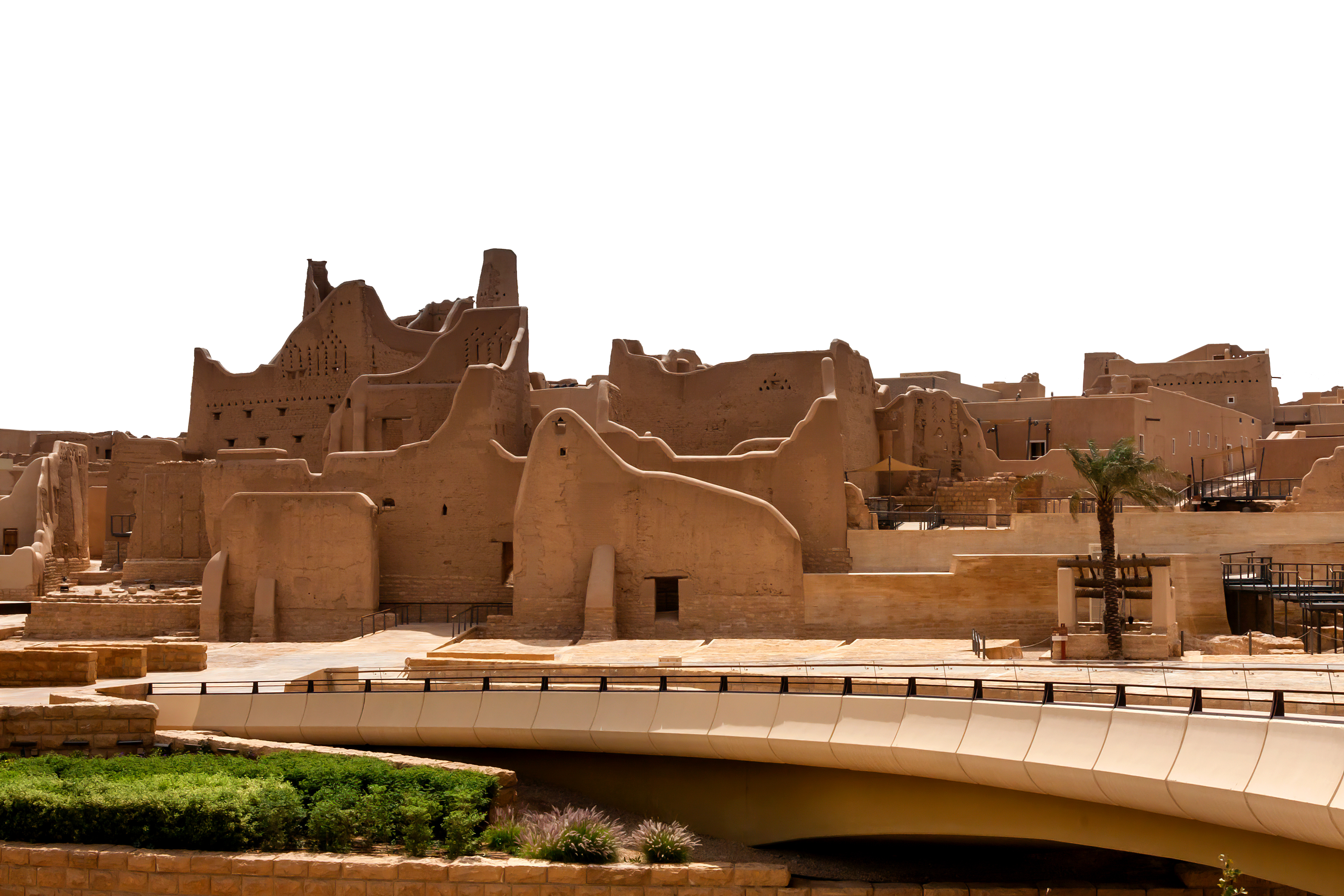
At-Turaif in Diriyah is a UNESCO World Heritage Site and the ancestral seat of the Al Saud. The mud-brick palaces, mosques and city wall have been restored over the past decade and the site now reads as a coherent town rather than a ruin field. The Diriyah Pass costs roughly SAR 50–100 per person depending on time and season (entry is free from 1 May to 30 September), children twelve and under go free, and the fee is redeemable against food at Bujairi Terrace next door. Book on diriyah.sa; weekend evenings sell out. Allow three hours, more if you eat there. The full picture is in our Diriyah guide.
Fly RUH–ULH in the afternoon. Flynas and Saudia both run the route and it takes a little under two hours. AlUla’s airport is small and transfers to the valley take 20–35 minutes. Accommodation splits between the resorts strung along the Ashar and Ashaikhah valleys and simpler guesthouses near the Old Town; the range is wide and the resorts book out months ahead in winter, which our AlUla accommodation guide gets into.
Day 4 — Hegra, the Old Town and Elephant Rock
Hegra was Saudi Arabia’s first UNESCO World Heritage Site and is the reason most people come to AlUla. It was the southern city of the Nabataean kingdom, the same civilisation that built Petra, and 111 monumental tombs are carved into its sandstone outcrops. The facade of the Tomb of Lihyan son of Kuza, unfinished and standing alone against open desert, is the image the region is known for.
You cannot walk in unaccompanied. Access is by guided tour only, on a coach or in a private 4x4, with tours starting from SAR 95 per person and running about two hours. Book on experiencealula.com before you arrive — daily capacity is capped and winter slots go weeks in advance. Morning departures are cooler and the low light on the east-facing tombs is better.
Spend the afternoon in AlUla Old Town, a stack of about 900 mud-brick houses that was continuously inhabited until the 1980s. The restored lane through it now holds cafes and craft shops, and the ruined quarter behind is open to walk. End at Elephant Rock (Jabal AlFil), a wind-carved outcrop 11 km northeast of town with sunken seating areas and a drinks kiosk at its base. Sunset is the point; it is crowded and worth it anyway.
Day 5 — Jabal Ikmah, then the flight to Jeddah
Jabal Ikmah is a narrow canyon covered in hundreds of Dadanitic, Thamudic, Minaic and Aramaic inscriptions, inscribed on the UNESCO Memory of the World register in 2023. It is a quiet, short visit — an hour is enough — and it gives the rest of AlUla its context: this valley was a stop on the incense route long before the Nabataeans arrived. Dadan, the capital of the Lihyanite kingdom with its lion tombs cut high into the cliff, is a few minutes away and usually sold as a combined ticket.
If you would rather be outdoors, Sharaan Nature Reserve runs guided hikes and mountain-bike routes through the sandstone canyons, and the Arabian leopard reintroduction programme is based there. Book through the same platform.
Take the afternoon flight ULH–JED, about 1 hour 20 minutes. In Jeddah, staying near Al-Balad puts you inside the historic district; the Corniche hotels are quieter and better for sea views but need a car for everything else.
Day 6 — Historic Jeddah
Al-Balad has been a UNESCO World Heritage Site since 2014 and is the last substantially intact Red Sea merchant town. The houses are built from coral rag quarried out of the sea and faced with rawasheen, the carved wooden lattice balconies that shaded rooms before air conditioning. Nasseef House, where King Abdulaziz stayed in the 1920s, is open to visitors and its ramp-shaped staircase was built wide enough for camels.
Go early or late; the middle of the day is hot and most of the district is unshaded. Souq Al Alawi runs through the centre for spices, textiles and gold. Restoration is active, so some lanes are fenced off on any given visit. Eat seafood — Jeddah’s is the best in the country, and a full meal in Al-Balad runs well under what a hotel restaurant charges.
In the late afternoon, move to the Corniche. King Fahd’s Fountain, the tallest of its kind in the world, throws seawater over 300 m and is floodlit after dark. The Corniche walkway is about 30 km long, with rental bikes at several points. Our Jeddah weekend itinerary has a denser version of this day if you want to add a second one.
Day 7 — Last morning and departure
Al Rahmah Mosque, built on stilts over the water at the northern end of the Corniche, is a short ride from most hotels and looks like it is floating at high tide. Non-Muslim visitors are generally not admitted inside; the exterior and the seafront are the visit. From there it is 30–45 minutes to King Abdulaziz International (JED), longer in Thursday evening traffic. Terminal 1 handles most international departures.
What the week costs
Excluding international flights, a realistic mid-range budget is SAR 550–900 per person per day in Riyadh and Jeddah, covering a three- to four-star hotel, meals, ride-hailing and entry fees. AlUla runs higher: accommodation there is the single largest line in the trip and can double the daily figure on its own. The two internal flights typically land between SAR 300 and SAR 700 per leg when booked three or more weeks out, and rise sharply closer to departure and over Saudi school holidays.
The costs you can fix early are the ones that move most: eVisa SAR 535, Hegra from SAR 95, Diriyah Pass SAR 50–100. Everything else is accommodation, and accommodation in AlUla is what decides whether this week is a moderate trip or an expensive one. If you are working to a tighter number, our budget guide shows where the savings actually are.
Practical notes
- Prayer times. Smaller shops and some restaurants close for 20–30 minutes at each of the five daily prayers. Museums and major attractions increasingly stay open. Plan around the midday and afternoon prayers rather than being surprised by them.
- SIM cards. STC, Mobily and Zain all sell tourist data packages at the arrivals halls; you need your passport to register. An eSIM bought before departure saves the queue.
- Photography. Ask before photographing people, particularly women. Government buildings, airports and military sites are off limits.
- Friday mornings are quiet almost everywhere. Treat Friday as a museum-and-desert day rather than a souq day.
- Booking order. Hegra and AlUla accommodation first, then the internal flights, then everything else. Those two are the constraints; the rest of the week bends around them.
If a week feels tight for what you want to see, the same three stops plus the Eastern Province and Asir fit comfortably into fourteen days — that version is in our two-week itinerary.
Turning this route into your dates
The order above works in either direction, and which way round you fly depends mostly on what Hegra has open in your week. Put your dates and interests into the Trip Planner and it will build the day-by-day version around them, and compare what is bookable in each city in our hotel guide.
Frequently Asked Questions
- Can I visit Makkah or Madinah during a one-week trip?
- Makkah is closed to non-Muslims - the entire city, not just the Grand Mosque, and checkpoints on the approach roads enforce it. Madinah city is open to all visitors, but the Haram zone around the Prophet's Mosque is restricted to Muslims. Umrah travel runs on its own visa track and is a separate trip from a sightseeing week.
- Should I fly or drive between Riyadh, AlUla and Jeddah?
- Fly. Riyadh to AlUla is around 1,000 km and Jeddah to Riyadh about 850 km, so each drive would consume a full day of a seven-day trip. Flynas, Flyadeal and Saudia all serve these routes; fares are typically SAR 300-700 per leg when booked three or more weeks ahead.
- How far in advance do I need to book Hegra?
- Weeks, for travel between October and March. Hegra is accessible by guided tour only, with daily capacity capped. Tours start from SAR 95 per person and run about two hours; book on experiencealula.com, the official platform. Morning departures are cooler and better lit for photography.
- How much should I budget per day?
- Roughly SAR 550-900 per person per day in Riyadh and Jeddah for a mid-range hotel, meals, ride-hailing and entry fees. AlUla is materially more expensive because of accommodation and can double that daily figure on its own. Internal flights and the SAR 535 eVisa sit on top.
- What do I need to wear?
- Women have not been required to wear an abaya or headscarf since 2019. Modest dress is expected of all visitors: shoulders and knees covered, nothing tight or transparent. A headscarf is needed to enter a mosque, and men wear long trousers outside beach and sports settings.
- When is the best time to do this itinerary?
- October to March. Riyadh and AlUla regularly exceed 40 C from May to September, and most of what this route covers - Hegra, Old Town, At-Turaif, Al-Balad - is outdoors. Desert nights in AlUla drop into single digits in January, so bring a jacket.