48 Hours in Riyadh: A Weekend Itinerary
A realistic 48-hour Riyadh itinerary: At-Turaif opens at 5pm, the National Museum is free and shuts Sundays. Plan Diriyah, Edge of the World and the metro right.
Key Takeaways
- At-Turaif at Diriyah opens at 5:00pm daily (last entry 11:00pm) - it is an evening site, not a morning one
- The National Museum of Saudi Arabia is free to enter but closed on Sundays; Friday opens only at 2:00pm
- Diriyah access is free from 1 May to 30 September 2026; outside that window a pass is about SAR 50 and is redeemable as Bujairi Terrace dining credit
- Edge of the World needs a 4x4 and a guide - budget SAR 400-800 per person for a half-day tour and leave by 7:00am
- All six metro lines run since January 2025: SAR 4 for a two-hour pass, or tap a contactless card straight at the gate
- The metro does not reach Diriyah or Edge of the World - use Uber, Careem or your tour transport
Riyadh works differently from most capitals, and the difference matters for a short trip. At-Turaif — the mud-brick UNESCO district at Diriyah that most visitors come for — does not open until 5:00pm. Plan it as a morning stop, as many itineraries still suggest, and you will drive out there to find the gates shut.
So this itinerary is built around the city's actual clock: indoor and heritage sites in the mornings, the desert at dawn, Diriyah after dark. Two days is enough for the capital's core if you sequence it correctly. It is not enough to add AlUla or Jeddah — those need their own trips.
Quick Facts for Your Riyadh Weekend
- Currency: Saudi Riyal (SAR), pegged at 3.75 to the US dollar since 1986. Cards are accepted almost everywhere; see our Riyadh payment guide for where cash still helps.
- Visa: Citizens of 66 countries can get an eVisa online for SAR 535 (about USD 143, including mandatory medical insurance) or visa on arrival for roughly SAR 480. It is valid one year, multiple entry, up to 90 days per visit. Details: visa on arrival guide.
- Weekend: Friday and Saturday. Friday mornings are quiet — many venues open only after midday prayers.
- Best months: November to March. June to August regularly passes 45°C, which reshapes what is realistic outdoors.
- Dress: Abaya has not been mandatory for visitors since 2019. Shoulders and knees covered is the working standard for men and women.
- Alcohol: Illegal for everyone, including tourists. There is no tourist exemption.
- Getting around: Six metro lines and 85 stations, plus Uber and Careem. Rental car only if you are driving yourself out of the city.
Day 1: Museums by Day, Diriyah by Night
Start at the National Museum of Saudi Arabia in the Al-Murabba district on King Saud Road. Admission is free — you book a slot on the Ministry of Culture's site, but you pay nothing. Its eight galleries run from pre-Islamic Arabia through the founding of the modern Kingdom, and two hours here will make everything you see later at Diriyah legible rather than just photogenic.
Note the hours carefully: Monday to Saturday 9:00am–7:00pm, Thursday 9:00am–10:00pm, Friday 2:00pm–10:00pm, and closed Sunday. If your weekend is Friday–Saturday, the museum is a Friday afternoon or Saturday morning stop, not a Friday morning one.
Next door sits Murabba Palace, the mud-brick residence King Abdulaziz built in the 1930s and lived in until his death. It is small, takes 30–45 minutes, and is the clearest surviving picture of how the royal court actually operated before oil money rebuilt the city.
From there, head to Al-Masmak Fortress in the old Ad-Dirah quarter, roughly 15 minutes away. This is the clay-and-mud fort Abdulaziz stormed in 1902 to retake Riyadh — the spearhead lodged in the wooden door is still there. It is compact; an hour is plenty.
Late afternoon: Souq Al-Zal
Souq Al-Zal is a few minutes' walk from Al-Masmak and has been trading since around 1901. Carpets, oud, brass coffee pots, old daggers, prayer beads. It fills up in the late afternoon and haggling is expected — the first number is an opening position, not a price. Buy nothing you cannot carry home, and ask before photographing anyone.
Evening: At-Turaif and Bujairi Terrace
Now the day's centrepiece. At-Turaif opens daily at 5:00pm and runs to midnight, with last entry at 11:00pm. This is the capital of the First Saudi State, abandoned after the Ottoman siege of 1818 and painstakingly restored — Salwa Palace, the Imam Mohammed bin Saud Mosque, the residential quarters, all in Najdi mud-brick that turns amber under the site's lighting. Give it two to three hours.
Pricing moves seasonally, so check before you go rather than trusting a fixed number. As of July 2026, Diriyah access is free from 1 May through 30 September. Outside that window a Diriyah Pass runs around SAR 50 for evening entry and is typically redeemable as dining credit at Bujairi Terrace, which effectively makes it free if you eat there. Under-12s enter free. Buy only through diriyah.sa — the site warns repeatedly about resellers.
Bujairi Terrace, the dining precinct overlooking At-Turaif, runs 9:00am to 3:00am and is where you should eat. Expect SAR 150–300 per person at the sit-down restaurants. Parking at Bujairi is SAR 10 per hour; valet is SAR 195, though restaurants there currently comp valet on a SAR 150 spend. Roadworks around Diriyah are constant — check the announcements on diriyah.sa the morning of your visit, since access routes change with little notice.
Our Diriyah heritage guide goes deeper on the site's history and layout.
Day 2: Desert at Dawn, City at Night
The Edge of the World (Jabal Fihrayn) is a roughly 90-kilometre run northwest of Riyadh, where the Tuwaiq Escarpment drops away into what was an ocean floor. The last stretch is unpaved and genuinely requires a 4x4 with someone who knows the track — this is not a sedan-and-Google-Maps trip, and people get stranded out there every season.
Go with an operator. Half-day tours leave central Riyadh around 6:00–7:00am, run SAR 400–800 per person including transport and water, and get you to the cliffs before the heat. The drive is 1.5–2 hours each way. Wear closed shoes with grip, bring more water than you think you need, and stay back from the edge — there are no railings, and that is the point.
Sunset trips exist and the light is better, but they return late and cost you the evening. On a two-day trip, the morning run is the better trade. If you would rather stay closer to town, our desert sunset spots near Riyadh covers shorter alternatives.
Afternoon: recover, then coffee
You will be back by early afternoon and you will be tired. Riyadh's specialty coffee scene is genuinely good and a reasonable way to spend a hot afternoon indoors — we mapped the better roasters in our Riyadh coffee guide.
Evening: the modern city
Two options, depending on what you want.
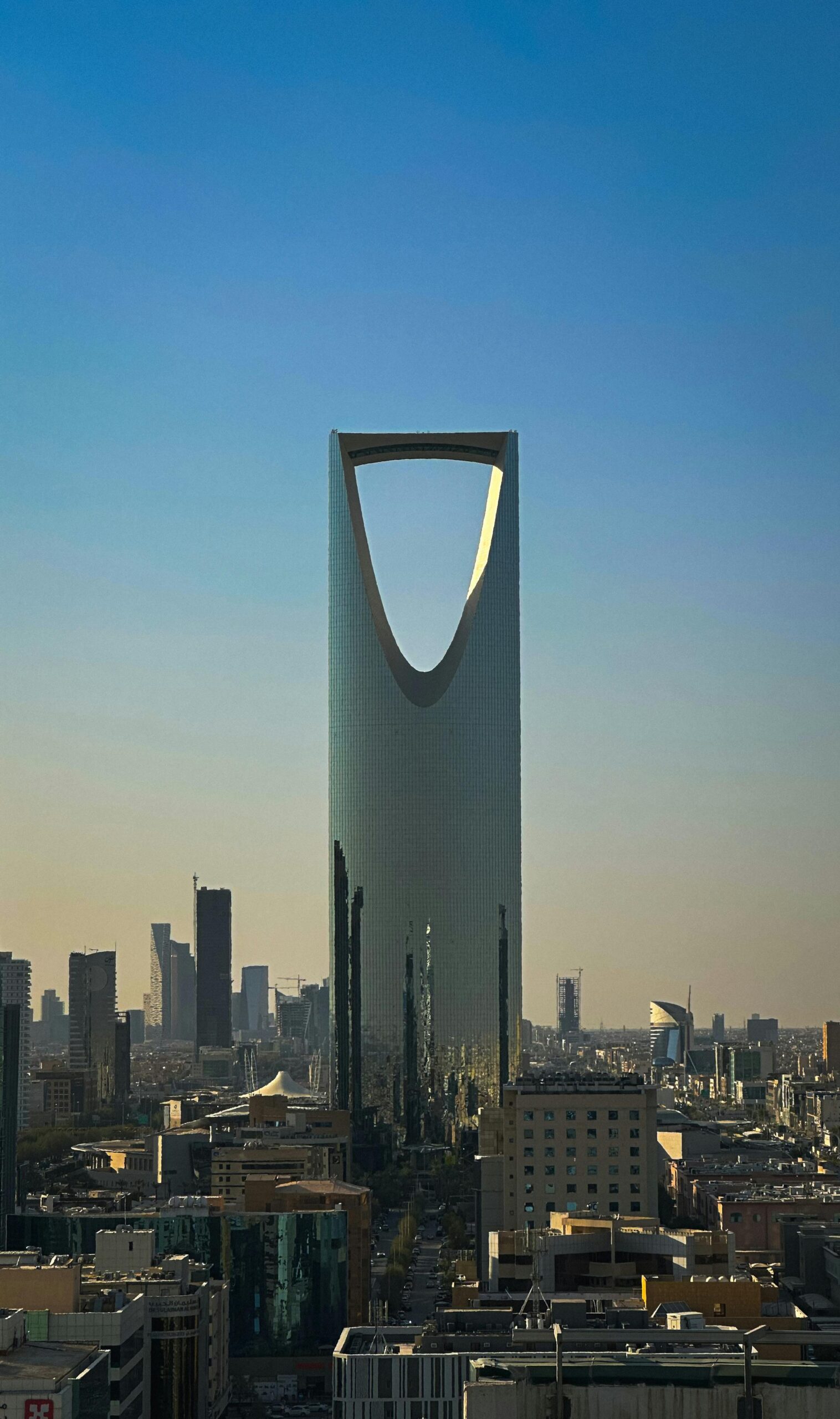
The Sky Bridge at Kingdom Centre spans the tower's inverted arch on the 99th floor, 300 metres up, and gives you the full sweep of the city. It opens around midday and runs into the evening. One caution: ticket pricing changed in 2026 and published figures currently disagree with each other, so check the price at the ground-floor counter or on the official channel before committing — do not budget off an old blog number. Most people spend 20–40 minutes up there. Aim for the hour before sunset.
Alternatively, Boulevard Riyadh City is the entertainment district that anchors Riyadh Season from roughly October to March — concerts, restaurants, shows, crowds. Outside those months much of it winds down, so check what is actually running before you plan an evening around it.
For dinner, Najd Village serves Najdi food — kabsa, jareesh, mandi — in traditional floor seating, and is the more interesting choice if you have been eating hotel food. Budget SAR 150–400 per person across Riyadh's mid-to-upper restaurants.
Getting Around
The metro has been running all six lines since January 2025 — 85 stations, driverless, and dramatically better than the traffic. A two-hour pass is SAR 4. A reloadable Darb card costs about SAR 10 and also covers city buses; gates accept contactless Visa and Mastercard and Apple Pay directly, so you may not need a card at all. Trains run 5:30am to midnight Saturday to Thursday, and from 10:00am on Fridays.
The metro does not reach Diriyah or the Edge of the World. For those, use Uber or Careem (both work well and are cheap by European standards) or your tour's transport. Ride-hailing across the city typically runs SAR 15–40 per trip.
Practical Notes
- Book ahead: the Edge of the World tour and your At-Turaif slot. Both sell out on weekends in cool season.
- Friday timing: shops and many attractions close for midday prayers and reopen mid-afternoon. Do not schedule anything tight around 12:00–1:30pm.
- Heat: from May to September, treat 11:00am–4:00pm as indoor time. This is not caution, it is arithmetic.
- SIM card: STC, Mobily or Zain at the airport, cheap, five minutes, passport required.
- Photography: ask before photographing people, women especially. Avoid government and military buildings.
- Makkah and Madinah: Makkah is closed to non-Muslims entirely. It is not on this itinerary and cannot be.
Where to Stay
Olaya and the King Fahd Road corridor put you near the metro, the Sky Bridge and most dining, and it is the simplest base for a two-day trip. The Diriyah side is quieter and more atmospheric but leaves you dependent on taxis. We compare both in Luxury vs. Heritage: Where to Stay in Riyadh.
If this weekend leaves you wanting more of central Arabia, Short Trips from Riyadh covers what is reachable in a day or two, and the Riyadh Travel Guide goes broader than a 48-hour window allows.
Two days is tight. Getting the order right is the whole game.
An At-Turaif evening, a dawn desert run and a museum that closes on Sundays have to be slotted around each other — our Trip Planner builds the sequence around your actual dates and flight times, and the hotel guide helps you pick between an Olaya base and a Diriyah one before you book.
If your weekend falls on 3–4 December, the city has a very different centre of gravity — see our Soundstorm guide.
Frequently Asked Questions
- How many days do you need in Riyadh?
- Two full days covers the core: the National Museum, Murabba Palace, Al-Masmak, Souq Al-Zal, At-Turaif at Diriyah, and one desert trip to the Edge of the World. A third day lets you slow down or add Boulevard Riyadh City. Adding AlUla or Jeddah needs a separate trip, not an extra day.
- What time does At-Turaif in Diriyah open?
- At-Turaif opens daily at 5:00pm and closes at midnight, with last entry at 11:00pm. It is an evening site. Bujairi Terrace, the adjacent dining precinct, runs from 9:00am to 3:00am. Check diriyah.sa before you travel, as access roads around Diriyah close frequently for construction.
- How much does it cost to enter Diriyah and the National Museum?
- As of July 2026, Diriyah access is free from 1 May to 30 September. Outside that window a Diriyah Pass is roughly SAR 50 for evening entry, usually redeemable as dining credit at Bujairi Terrace, with under-12s free. The National Museum of Saudi Arabia is free year-round, though you should book a slot. Buy Diriyah passes only via diriyah.sa.
- Do I need a visa to visit Riyadh?
- Citizens of 66 eligible countries can apply for a Saudi eVisa online for SAR 535 (about USD 143), which includes mandatory medical insurance, or get a visa on arrival at Riyadh airport for roughly SAR 480. It is valid for one year, multiple entry, up to 90 days per visit, and covers tourism and Umrah but not Hajj or work.
- Can I drive to the Edge of the World myself?
- Not in a normal car. The final stretch to Jabal Fihrayn is unpaved and requires a 4x4 plus someone who knows the route; visitors get stranded there regularly. Go with an operator - half-day tours run SAR 400-800 per person including transport and water, and leave central Riyadh around 6:00 to 7:00am to beat the heat.
- Is the Riyadh Metro useful for tourists?
- Yes, for the city itself. All six lines and 85 stations have run since January 2025. A two-hour pass is SAR 4, a reloadable Darb card is about SAR 10, and gates accept contactless Visa, Mastercard and Apple Pay directly. Trains run 5:30am to midnight Saturday to Thursday and from 10:00am Friday. It does not reach Diriyah or the Edge of the World.