UNESCO Archaeological Tour Saudi Arabia: 10 Days
10-day UNESCO archaeological tour Saudi Arabia: Hegra, At-Turaif, Hail rock art & Hima. Day-by-day logistics, costs & booking tips.
L'essentiel à retenir
- Saudi Arabia has 7 UNESCO World Heritage Sites — this tour covers 5 in 10 days
- Route: Diriyah At-Turaif (Riyadh) to Hegra (AlUla) to Al-Balad (Jeddah) to Rijal Almaa (Asir) to Al-Ahsa
- Jubbah rock art near Hail and Al-Faw archaeological site near Wadi ad-Dawasir complete the 7 sites
- Pre-book all timed entries especially Hegra — UNESCO sites have visitor caps during peak season
- A local archaeological guide transforms this from sightseeing into genuine historical education
Travel advisory note: this guide includes destinations in Saudi Arabia's far south — Najran, Sharurah, Jazan province and the Farasan Islands — close to the Yemeni border. As of 2026 the US State Department rates Saudi Arabia overall at Level 3 — Reconsider Travel (reissued 13 March 2026) and applies Level 4 — Do Not Travel to the area within 20 miles of the Yemen border; the UK and Canada take a comparable line. Check your own government's current guidance before planning travel to these areas, and note that travel insurance is usually void in do-not-travel zones. See our Saudi Arabia safety guide. The rest of the country is not covered by these border restrictions.
Itinerary at a Glance
- Duration: 10 days / 9 nights
- Route: Riyadh → Hail → AlUla → Najran → Riyadh
- UNESCO Sites: 4 — At-Turaif, Hail Rock Art, Hegra, Hima Cultural Area
- Budget: SAR 12,000–25,000 (USD 3,200–6,700) excluding international flights
- Best Season: October–April (15–30°C daytime)
- Transport: 3 domestic flights + guided 4x4 excursions
- Visa: e-Visa available for citizens of 66 countries
Saudi Arabia holds six UNESCO World Heritage Sites — and four of them are archaeological treasures that span over 10,000 years of human history. This 10-day itinerary connects them into a single, logistically practical journey that moves from the mud-brick palaces of Diriyah to the Nabataean tombs of AlUla, through 10,000-year-old rock art galleries and ancient caravan inscriptions stretching to the Yemeni border.
This is not a highlights tour — it is a deep archaeological circuit designed for travellers who want to understand Arabia's role in human civilisation, from Neolithic pastoralists to Nabataean traders to the founders of the modern Saudi state.
Why This UNESCO Archaeological Tour Matters
Saudi Arabia's archaeological heritage was largely inaccessible to international visitors until 2019. The sites on this itinerary represent a combined chronology stretching from the late Paleolithic (~10,000 BCE) to the 18th century CE — a span of human activity unmatched by most archaeological circuits worldwide. The Kingdom's investment in conservation and visitor infrastructure under Vision 2030 means these sites are now accessible with world-class guiding, yet still refreshingly uncrowded compared to equivalent sites in Egypt, Jordan, or Turkey.
Days 1–2: Riyadh & At-Turaif (Diriyah)
Day 1: Arrival & National Museum
Arrive at King Khalid International Airport (RUH). After checking into your hotel — we recommend the Diplomatic Quarter or Olaya district for convenience — head to the National Museum of Saudi Arabia within the King Abdulaziz Historical Centre. Its eight halls provide essential chronological context for everything you will see over the next 10 days, from prehistory through the Islamic period to the Saudi state. Allow 2–3 hours. Entry: SAR 10–20.
Evening: Dinner at a traditional Najdi restaurant. For accommodation options, see our Riyadh hotel guide.
Day 2: At-Turaif — Birthplace of the Saudi State
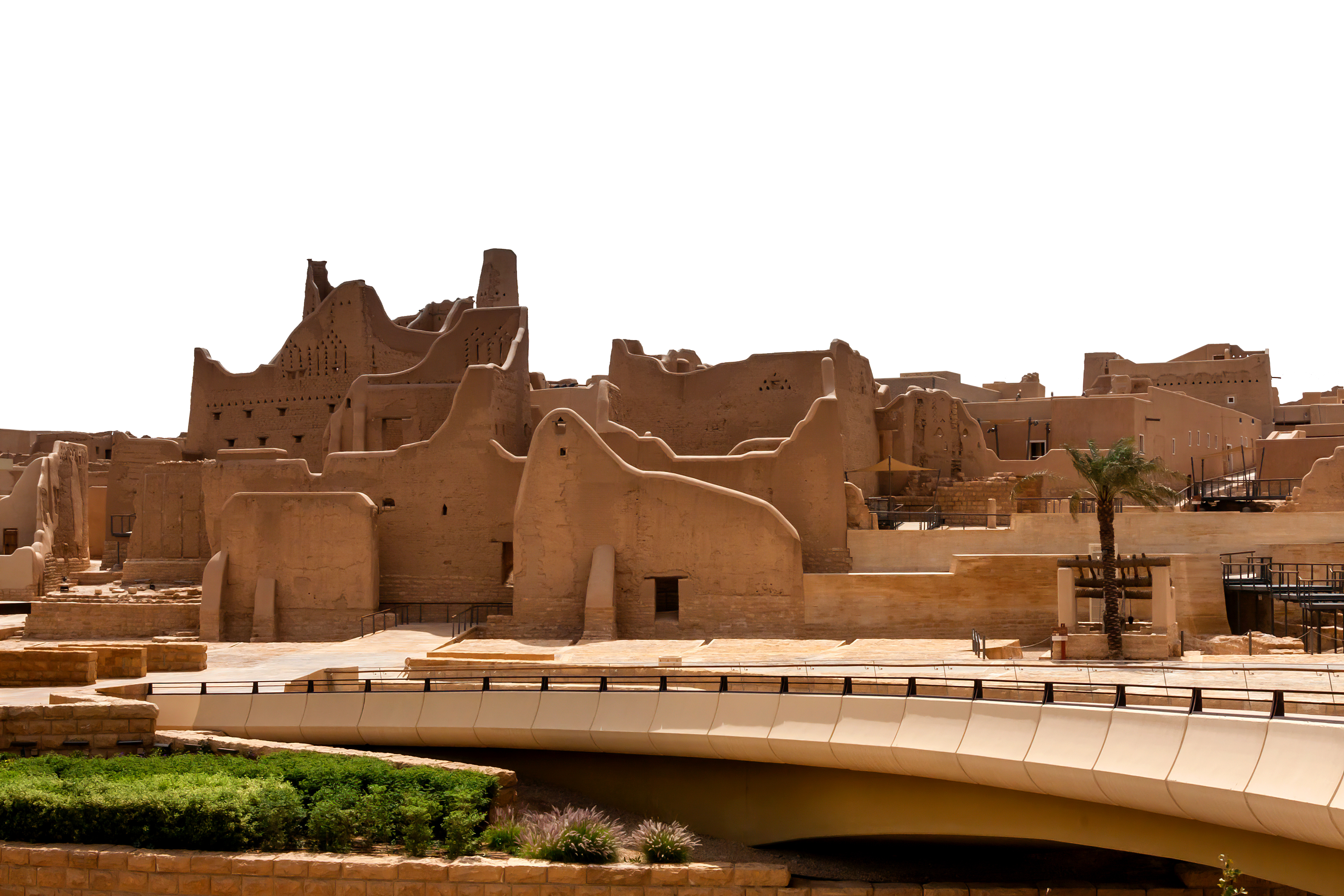
Dedicate the full morning and early afternoon to At-Turaif, Diriyah's UNESCO-inscribed mud-brick district. Founded in 1744 as the capital of the First Saudi State, At-Turaif is the political and architectural origin story of modern Saudi Arabia.
The meticulously restored site includes Salwa Palace (the royal residence), the Imam Mohammed bin Saud Mosque, and interactive museums documenting the district's history. The traditional Najdi architecture — thick mud-brick walls with geometric triangular ventilation patterns — is unique to this region and represents a building tradition adapted to extreme desert conditions.
- Entry: SAR 100–150 (USD 27–40). Book online via the Diriyah Gate website.
- Duration: 4–5 hours for thorough exploration.
- Tip: Return at sunset for the illumination experience — At-Turaif's mud walls glow gold under theatrical lighting.
- Lunch: Bujairi Terrace, the contemporary dining hub overlooking At-Turaif.
Evening: Catch a domestic flight to Hail (1.5 hours). Flights depart daily from Riyadh.
Days 3–4: Hail Region Rock Art
Day 3: Jubbah — Jabal Umm Sinman
The Rock Art of the Hail Region (UNESCO 2015) encompasses two primary sites: Jubbah and Shuwaymis. Today, drive 90 km north from Hail city to Jubbah, where the towering sandstone outcrops of Jabal Umm Sinman rise from an ancient lakebed.
The petroglyphs here span over 10,000 years — from Neolithic depictions of long-horned cattle, ibex, and gazelles (evidence that this was once a lush savannah) to Thamudic and early Arabic inscriptions. The scale is extraordinary: thousands of individual carvings spread across multiple rock faces, each panel a chapter in the region's environmental and cultural transformation from green grassland to arid desert.
- Guide: Essential. Local guides interpret the chronological layers and navigate access routes. Arrange through your Hail hotel or a specialist tour operator.
- Duration: 4–5 hours on site.
- Facilities: Basic visitor centre at Jubbah. Bring water, sun protection, and sturdy shoes.
Day 4: Shuwaymis & Hail City
Morning: Drive south to Shuwaymis (~250 km from Hail), the second component of the UNESCO site. The rock art here is often larger and more detailed than Jubbah, featuring hunting scenes, animal processions, and some of the most vivid Neolithic art in the Middle East. A 4x4 with a local driver-guide is required — the site is genuinely remote.
Afternoon: Return to Hail city and explore Aarif Fort, which offers panoramic views of the city. Hail's Bedouin hospitality culture is legendary — accept any invitations to coffee.
- Transport: Full-day 4x4 hire with guide: ~SAR 800–1,200 (USD 215–320).
- Cultural note: Hail is associated with the pre-Islamic poet Hatim al-Tai, whose generosity became proverbial in Arabic literature.
Evening: Flight from Hail to AlUla (1 hour, or drive ~5 hours through dramatic volcanic landscape).
Days 5–7: AlUla & Hegra
Day 5: Dadan & Jabal Ikmah
Begin your AlUla exploration chronologically, starting with the Kingdoms of Dadan and Lihyan — the pre-Nabataean civilisation that controlled this oasis from the 9th century BCE. The carved lion tombs high on the cliff face are among the most striking ancient monuments in Arabia. Continue to Jabal Ikmah, an open-air library of thousands of inscriptions in Dadanitic, Minaic, Thamudic, and Nabataean scripts — evidence of AlUla's role as a multilingual crossroads of the ancient world.
- Tours: Book through Experience AlUla. Half-day Dadan + Ikmah tours: SAR 200–350.
Day 6: Hegra — Saudi Arabia's First UNESCO Site
The centrepiece of this itinerary. Hegra (Mada'in Salih), inscribed in 2008, was the southern capital of the Nabataean Kingdom — the same civilisation that built Petra. Over 110 monumental tombs are carved into sandstone outcrops across a vast desert plain, their facades blending Hellenistic columns, Egyptian cornices, and indigenous Arabian motifs.
The most iconic tomb, Qasr al-Farid ("the Lonely Castle"), stands alone against the desert sky, its unfinished facade revealing the Nabataean carving technique: top-down, with scaffolding holes still visible. Beyond the tombs, explore the ancient Diwan (council chamber), the Nabataean well system, and trilingual inscriptions that document the intersection of Greek, Aramaic, and Arabic cultures.
- Entry: SAR 150–300 (USD 40–80) via guided bus tours. Allow 3–4 hours minimum.
- Photography tip: The golden hour light on Qasr al-Farid is extraordinary — request a late-afternoon tour slot.
- Context: Hegra sat on the Incense Route connecting southern Arabia to the Mediterranean, controlling the trade in frankincense, myrrh, and spices.
Day 7: Old Town & Stargazing
Morning: Explore AlUla Old Town, the abandoned medieval settlement with over 900 mudbrick houses. Afternoon: See the Maraya concert hall (the world's largest mirrored building; interior access is limited to booked tours, ticketed events, or the rooftop restaurant — the exterior is viewable anytime) and hike in Sharaan Nature Reserve.
Evening: Stargazing at Gharameel — AlUla's premier dark sky site. The rock pillars create extraordinary silhouettes against the Milky Way. Book a 'Falak' (astronomy) guided experience.
- Accommodation: Habitas AlUla (eco-luxury), Banyan Tree AlUla, or heritage-style camps. Book months in advance for peak season.
Days 8–9: Najran & Hima Cultural Area
Day 8: AlUla to Najran
Fly from AlUla to Najran via Riyadh connection (total ~5 hours including layover). Najran, in Saudi Arabia's far south near the Yemeni border, is one of the Kingdom's least-visited regions and among its most rewarding.
Afternoon: Explore Al-Ukhdood Archaeological Site in Najran — the remains of an ancient city mentioned in the Quran, with pre-Islamic inscriptions and building foundations. Continue to Najran Fort (Qasr al-Emara), a striking mud-brick palace that now serves as a museum.
Day 9: Hima Cultural Area
Drive 200 km north of Najran to the Hima Cultural Area (UNESCO 2021) — one of the largest open-air rock art galleries in the world. Tens of thousands of petroglyphs and inscriptions document over 7,000 years of human activity along the ancient caravan routes connecting Arabia to Mesopotamia and the Horn of Africa.
The inscriptions are written in multiple ancient scripts — Musnad (South Arabian), Thamudic, Nabataean, and early Arabic — creating a multilingual archive of trade, travel, and daily life. Animal depictions include camels, ibex, lions, and ostriches, many accompanied by brand marks and travel tallies that functioned as ancient "road signs."
- Access: 4x4 with local guide essential. Arrange through Najran tourism office or specialist operator. Full-day excursion: ~SAR 600–1,000.
- Facilities: Minimal on site. Pack water, food, and sun protection for a full day.
- Note: As the newest UNESCO site on this itinerary, infrastructure is still developing. This adds to the frontier-exploration feeling but requires careful planning.
Evening: Return to Najran. Late flight to Riyadh (1.5 hours).
Day 10: Riyadh Wrap-Up & Departure
Morning: Final exploration in Riyadh. Options include the architectural walking tour, specialty coffee tour, or shopping at Al-Zal Souq for traditional crafts and souvenirs. Afternoon/evening: departure from King Khalid International Airport.
Complete Logistics Guide
Flights & Transport
- Day 2 evening: Riyadh → Hail (Saudia/flynas, ~1.5 hrs, SAR 300–600)
- Day 4 evening: Hail → AlUla (flynas, ~1 hr, SAR 250–500) or drive (~5 hrs)
- Day 8 morning: AlUla → Riyadh → Najran (connection, ~5 hrs total, SAR 500–900)
- Day 9 evening: Najran → Riyadh (Saudia, ~1.5 hrs, SAR 300–600)
- Booking tip: Book domestic flights 4–6 weeks ahead for best rates. Flynas and Saudia are the primary carriers.
Budget Breakdown (Per Person)
- Flights (4 domestic): SAR 1,400–2,600
- Accommodation (9 nights): SAR 3,500–12,000 (budget to luxury)
- Site entries & tours: SAR 1,500–3,000
- Guided 4x4 excursions (Hail + Hima): SAR 1,400–2,200
- Food & transport: SAR 2,500–4,500
- Total: SAR 10,300–24,300 (USD 2,750–6,500)
For detailed cost planning, see our Saudi Arabia budget guide.
Visa & Documentation
The Saudi tourist e-Visa (SAR 535 including insurance) covers all sites on this itinerary. No special archaeological permits are required for standard visitor access. Some sites (notably Hima) may require coordination with local tourism offices — your tour operator will handle this.
What to Pack
- Sturdy walking shoes (rocky terrain at all sites)
- Sun protection: high-SPF sunscreen, wide-brimmed hat, sunglasses
- Layers for desert evenings (temperatures drop to 5–10°C October–March)
- Refillable water bottle (minimum 2L capacity)
- Camera with wide-angle lens for tomb facades and rock panels
- Modest clothing — see our dress code guide
Guided vs. Independent
This itinerary is designed to be independently bookable — you arrange your own flights, hotels, and site tours separately. However, for Hail rock art and Hima, a local guide with 4x4 is essential (not optional). For a fully managed experience, specialist archaeological tour operators offer the complete 10-day circuit at SAR 20,000–40,000 per person all-inclusive.
"The archaeology of Saudi Arabia is the great untold story of human civilisation. These are not minor regional sites — they are globally significant monuments that rewrite our understanding of ancient trade, religion, and migration. And unlike their counterparts in Egypt or the Levant, you can still experience them in near-solitude." — Dr. Laila Nehmé, Hegra excavation director
Plan Your Saudi Adventure
Ready to experience the Kingdom? Our AI-powered Trip Planner creates personalized itineraries based on your interests, budget, and travel dates. From Riyadh's skyline to AlUla's ancient tombs — let us help you discover Saudi Arabia your way.
Questions fréquentes
- UNESCO sites for 10-day tour?
- Diriyah (First Saudi State capital), AlUla Madain Saleh (Nabatean sandstone tombs), Rock Art Jubbah and Um al Quwain. Represent distinct periods from pre-Islamic trade to early Islamic.
- Time per UNESCO site?
- Plan 2-3 days AlUla with Madain Saleh, Old Town, Hegra Museum. 2 days Diriyah walking tours. 1-2 days Rock Art. 2-3 days travel and buffer.
- Need guide?
- Highly recommended especially Madain Saleh for history understanding and restricted tomb access. English tours available. Book advance. Private guides offer flexibility and context.
- Best route?
- Start Riyadh 1 day Diriyah, fly Jeddah, drive AlUla 3-4 days exploring Madain Saleh, return Riyadh with Rock Art day. Minimizes driving, maximizes quality time.