Photography Guide Saudi Arabia: Best Spots & Tips 2026
Where and when to shoot Saudi Arabia: Hegra at 07:30, Edge of the World at sunset, Al-Balad, Empty Quarter dunes. Tourists cannot legally fly drones here.
Key Takeaways
- Tourists cannot legally fly a drone in Saudi Arabia. GACA registration accepts only a Saudi national ID or Iqama, there is no visitor permit, and drones are routinely held at customs on arrival. Plan the shot list without aerials.
- Hegra in AlUla is entry by timed guided tour only, so you cannot wait for your light - book the first morning slot, roughly 07:30-08:00 in winter.
- Edge of the World (Jabal Fihrayn), about 90 km north-west of Riyadh, only works from late afternoon to sunset; midday light flattens the escarpment. Access needs a 4x4 and a guide.
- Shoot October to April. May to September is punishing in the interior and midday is largely unproductive.
- Always ask before photographing people, and treat refusal as final. Government, military, airport and border infrastructure are off-limits, and commercial photography needs a separate permit arranged weeks ahead.
- The Asir highlands around Abha (about 2,200 m) get the highest rainfall in the country and morning cloud from June to September - the strongest counterpoint to standard Saudi desert imagery.
- Jazan, Najran and the Farasan Islands lie in or near the Yemen border advisory zone. Check your government's current guidance before planning any southern trip.
Travel advisory note: parts of this guide cover Saudi Arabia's far south — Jazan province, the Farasan Islands and Najran — which lie close to the Yemeni border. As of 2026 the US State Department rates Saudi Arabia overall at Level 3 — Reconsider Travel (reissued 13 March 2026) and applies Level 4 — Do Not Travel to the area within 20 miles of the Yemen border; the UK and Canada take a comparable line, citing drone and missile activity, exit restrictions and disrupted air traffic. Travel insurance is commonly void in do-not-travel zones. Check your own government's current guidance before planning any trip to these areas. See our Saudi Arabia safety guide. The rest of the country is not covered by these border restrictions.
Before the gear: the two rules that decide your trip
Two things shape photography in Saudi Arabia more than any lens choice, and both are worth settling before you book.
Drones are effectively closed to visitors. Every drone must be registered with the General Authority of Civil Aviation (GACA) before it is flown, and the registration portal accepts only a Saudi national ID or a valid Iqama residence permit. A tourist has neither, so there is no route to a legal flight — there is no visitor permit, no temporary registration and no exemption. Drones are also routinely held at customs on arrival, sometimes for months, and returned without flight permission. Plan your shot list without aerials. If you need altitude, the alternatives are a hot air balloon flight in AlUla, which operates commercially and carries its own authorisation, or elevated public viewpoints such as the Kingdom Centre Sky Bridge in Riyadh.
People are the other rule. Ask before photographing anyone, and treat a refusal as final — this matters most with women and children. Government buildings, military installations, airports and border infrastructure are off-limits. Street photography in tourist districts is unremarkable if you are visibly polite about it. Commercial photography, meaning anything beyond personal use, needs its own permit, and that process should start weeks ahead rather than on arrival.
AlUla: the highest concentration of subjects
If you have one location, make it AlUla. Hegra, the UNESCO-inscribed Nabataean necropolis, holds 111 tombs cut into freestanding sandstone outcrops, and entry is by timed guided tour only — which is a constraint worth planning around, because you cannot simply wait for your light. Book the first morning slot, roughly 07:30 to 08:00 in winter, when low sun turns the rock faces pink and the shadow separation on the tomb facades is at its strongest. A wide-angle covers the scale, a 70-200 isolates the carved detail.
Elephant Rock (Jabal AlFil), a 52-metre outcrop weathered into an unmistakable shape, needs no booking and stays open after dark with low-impact lighting and fire pits. It works twice: silhouette at sunset, then a lit foreground against the first stars. Maraya, the mirror-clad concert hall in the Ashar Valley and the largest mirrored building in the world by Guinness World Records, is the one guaranteed frame in the valley — the exterior is photographable at any hour, and the reflection changes completely between hard midday light and low sun. AlUla Old Town, mud-brick and cliff-backed, is the valley's street-photography location, best in the last hour of daylight. Full logistics are in our AlUla travel guide.
Edge of the World, and the Riyadh region
Jabal Fihrayn, known as the Edge of the World, sits roughly 90 km north-west of Riyadh where an escarpment drops away into what was once an ocean bed. Late afternoon into sunset is the window: the golden light rakes across the cliff face and the lengthening shadows give the drop its depth, which midday light flattens completely. Access generally needs a 4x4 and a guide, the track is rough, and facilities are absent — carry water for longer than you plan to stay. A tripod earns its weight here, both for the panoramas and for the night sky once the Riyadh glow drops behind the ridge.
In the city itself, Kingdom Centre Tower and Al Faisaliah dominate the skyline, and the Kingdom Centre Sky Bridge is the standard elevated viewpoint for the sunset-to-blue-hour transition. The King Abdullah Financial District is contemporary architecture at scale, though photography access is largely limited to public space. Souq Al-Zal is the older counterpoint. Diriyah, the mud-brick UNESCO site on the city's edge, is a different register again — see the Diriyah guide and the Riyadh travel guide.
Jeddah and Al-Balad
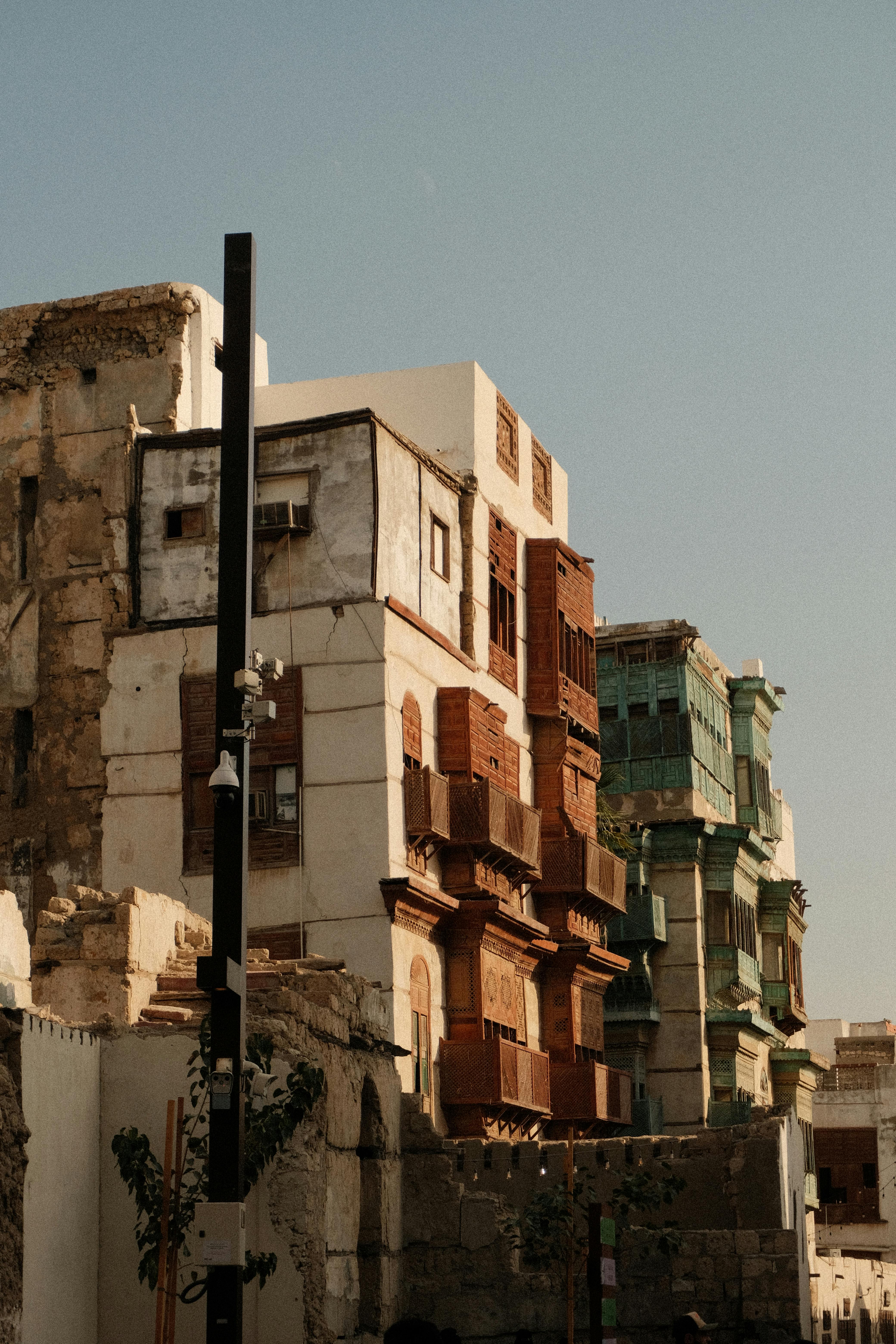
Al-Balad, Jeddah's UNESCO-listed historic district, is the country's densest architectural subject: multi-storey coral-stone houses fronted with rawashan, the carved wooden lattice balconies, along narrow alleys that hold reflected light long after the sun has left the street. Early morning gives you soft light and empty lanes; late afternoon gives you the district in use. Bab Makkah and Nassif House are the anchor structures. Our Al-Balad architectural walk maps a route through it, and the Jeddah travel guide covers the rest of the city.
On the water, the Corniche runs for kilometres along the Red Sea and gives you clean sunset compositions over open water — the rarer orientation in a country most people photograph facing east. King Fahd's Fountain is the landmark shot, strongest once it is lit after dark.
Desert: dunes, and the dark sky above them
The Rub' al-Khali, the Empty Quarter, is the largest continuous sand desert in the world and the most demanding location in this guide. It is not a day trip. It requires a properly equipped 4x4, an experienced guide, recovery gear and a route someone outside your vehicle knows about. The reward is dune form: side light at either end of the day picks out the ridge lines and drops the faces into shadow, and the colour moves from pale to deep red as the sun goes.
The Nafud in the north offers comparable form with redder sand and considerably shorter approach drives, with rock formations around Ha'il adding structure that pure dune fields lack. For anyone whose main target is the night sky rather than the dunes, an organised desert camp is the practical answer — you get a fixed location, a guide and a vehicle without assembling an expedition. See desert camps in Saudi Arabia and our stargazing guide for locations and timing.
For astrophotography, the practical kit is a fast wide-angle, a stable tripod and a remote or intervalometer; the limiting factor in the desert is not light pollution but dew, dust and battery temperature. Cold desert nights drain batteries faster than the spec sheet suggests, so carry more than you think and keep them warm.
Asir: the version of Saudi Arabia nobody photographs
The Asir highlands around Abha sit at roughly 2,200 metres and receive the highest rainfall in the country, which produces terraced green hillsides and, from June to September, morning cloud that spills over the escarpment. It is the strongest counterpoint to the desert imagery that dominates Saudi photography, and it is comparatively unphotographed. Rijal Almaa, the stone village with its painted interiors, is the set-piece. Note that Asir is a distinct region from the Jazan and Najran border areas described in the advisory note at the top of this guide.
Taif, on the escarpment above Jeddah, is the other highland option and considerably easier to reach — rose farms are the seasonal draw, with harvest concentrated in spring. See the Taif guide.
The coast
Saudi Arabia's Red Sea coastline is largely under development, which means access is uneven and changes between seasons. Existing stretches offer clear water, reef and small coastal settlements. Underwater work needs its own housing and its own planning, and dive operators are concentrated rather than distributed along the coast. Before committing to any southern coastal location, re-read the advisory note at the top of this page — the Farasan Islands sit within the region it describes.
Field notes
- Season: October to April for workable daytime conditions. May to September is punishing in the interior, and midday shooting is largely unproductive.
- Golden hour is shorter than you expect at this latitude. Scout the position the day before rather than arriving with the light.
- Dust is the real threat to gear. Change lenses inside a vehicle or a bag, carry a blower and a sealed bag, and keep bodies out of direct sun between shots.
- Heat and cold both cost you power. Carry spares well beyond your usual margin; there is no mains power on a desert night.
- Lenses: a wide-angle for AlUla, the escarpment and the night sky; a standard zoom for street and environmental portraits; a 70-200 or longer for tomb detail and compressed dune ridges.
- Storage: bring more cards than you need and back up daily — dust and heat are harder on cards than on sensors.
- Prayer times close some venues for 20 to 30 minutes, five times a day. Build it into a shooting schedule rather than discovering it at a locked door.
- Dress modestly at religious sites and in smaller towns: shoulders and knees covered. The abaya has not been required for foreign women since 2019, but a scarf is useful at mosques. See what to wear in Saudi Arabia.
- Currency: the riyal is pegged near SAR 3.75 to the US dollar, so costs are predictable.
- Getting to remote locations generally means a 4x4 and a guide. Budget for it as a line item, not an afterthought.
Building the route
Group your locations geographically or you will lose days to transfers. Riyadh pairs with Edge of the World and Diriyah. Jeddah pairs with Al-Balad and the coast. AlUla is a standalone leg that needs its own flight and at least three days. Asir is a separate trip again. Entry is the standard Saudi tourist eVisa — 66 nationalities, SAR 535 online including mandatory medical insurance or about SAR 480 on arrival, valid one year with up to 90 days per entry. Start the application early enough that a delay does not cost you the flight, and book accommodation ahead in peak season, particularly in AlUla where inventory is capped. The best time to visit guide sets the seasonal constraints out in full.
Turning a shot list into an actual route?
Photography trips here live or die on sequencing — AlUla needs its own flight and three days, and Edge of the World only works in the last hours of daylight. Lay the days out in our Trip Planner, and use the hotel guide to base yourself close enough to your locations that a pre-dawn start is realistic.
Frequently Asked Questions
- Can tourists fly a drone in Saudi Arabia?
- No. Every drone must be registered with the General Authority of Civil Aviation before flight, and the registration portal accepts only a Saudi national ID or a valid Iqama residence permit. Visitors have neither, and there is no temporary or tourist permit. Drones are also routinely held at customs on arrival and returned without flight permission. For elevated shots the practical alternatives are a commercial hot air balloon flight in AlUla or public viewpoints such as the Kingdom Centre Sky Bridge in Riyadh.
- What are the best photography locations in Saudi Arabia?
- AlUla has the highest concentration: Hegra's Nabataean tombs, Elephant Rock, Maraya and the mud-brick Old Town. Near Riyadh, Edge of the World for the escarpment and Diriyah for mud-brick architecture. In Jeddah, the coral-stone houses and rawashan balconies of Al-Balad plus the Red Sea Corniche. For desert form, the Rub' al-Khali or the redder, more accessible Nafud in the north. Asir around Abha is the green highland counterpoint.
- When is the best season for photography in Saudi Arabia?
- October to April. Daytime conditions are workable, skies are generally clear and the low winter sun gives longer, more usable light at either end of the day. May to September reaches punishing temperatures in the interior and midday shooting is largely unproductive. Golden hour is shorter at this latitude than many photographers expect, so scout positions the day before rather than arriving with the light.
- Are there restrictions on photographing people?
- Yes. Ask permission before photographing anyone and treat a refusal as final; this matters most with women and children. Government buildings, military installations, airports and border infrastructure are off-limits. Street photography in tourist districts is unremarkable if you are visibly polite about it. Anything beyond personal use counts as commercial photography and needs its own permit, which should be started weeks in advance.
- What gear should I bring for desert and night photography?
- A fast wide-angle for landscapes and the night sky, a standard zoom for street and environmental portraits, and a 70-200 or longer for tomb detail and compressed dune ridges. A stable tripod and a remote or intervalometer are needed for night work. The practical limits in the desert are dust, dew and battery temperature rather than light pollution - change lenses inside a vehicle, carry a blower and sealed bags, and bring well beyond your usual spare batteries, since cold desert nights drain them faster than the spec sheet suggests.