Ultimate Two-Week Saudi Arabia Itinerary 2026
Ultimate 14-day Saudi Arabia grand tour 2026: Riyadh, AlUla, Medina, Jeddah & Abha with expert day-by-day planning and honest tips.
Key Takeaways
- 14-day route: Riyadh (3) to AlUla (3) to Jeddah (3) to Abha (3) to Eastern Province (2)
- This requires 3-4 domestic flights — book all legs in advance for SAR 200-400 per segment
- The two-week format allows deeper exploration than the 7-day Golden Triangle without feeling rushed
- Include one rest day — back-to-back travel across Saudi Arabia vast distances causes fatigue
- Peak season October-March: book accommodation and Hegra tickets 2-3 months ahead
The Ultimate Two-Week Saudi Arabia Itinerary: 2026 Grand Tour
Two Weeks in Saudi Arabia – A Complete First-Time Journey
Saudi Arabia is not a destination to be rushed. Its scale, contrasts, and cultural depth demand time—time to understand the rhythm of its cities, the silence of its deserts, and the layered history that predates modern borders by thousands of years. A two-week itinerary offers the ideal balance: immersive without being overwhelming.
This carefully structured 14-day journey is designed for first-time visitors who want to experience the Kingdom beyond headlines. You will move from the contemporary energy of Riyadh to the ancient landscapes of AlUla, from the historic port city of Jeddah to the untouched coastline of the Red Sea. Along the way, you encounter UNESCO World Heritage sites, living traditions, emerging cultural districts, and some of the most striking natural scenery in the Middle East.
Distances are realistic, internal flights are used where appropriate, and each stop allows enough time to explore without fatigue. This itinerary reflects current travel conditions and infrastructure as they stand today—no speculation, no inaccessible projects.
Whether you are interested in culture, history, nature, or modern Saudi life, this two-week route provides a coherent, respectful, and deeply rewarding introduction to the country.
Why This Route Works
Saudi Arabia covers more than two million square kilometres, making route planning essential. This itinerary follows a logical geographic flow that minimises backtracking and fatigue. Major long distances are covered by domestic flights, while shorter regional explorations are done by car or guided transfers.
The journey begins inland in Riyadh, allowing travellers to understand the political and cultural heart of the Kingdom before moving northwest to AlUla's archaeological landscapes. From there, the route shifts west to Jeddah, historically Saudi Arabia's gateway to the world. The final days are spent along the Red Sea, where the pace naturally slows.
Each location is given enough time to explore meaningfully. No day is overloaded, and buffer time is built in for weather, cultural events, or personal interests. This structure makes the itinerary suitable both for independent travellers and for privately guided journeys.
- Visa: Tourist e-visa required for most nationalities. Apply online through Visit Saudi at least 72 hours before departure. The visa is valid for one year with multiple entries (up to 90 days per stay).
- Best Months: November to March offers ideal conditions for outdoor exploration and desert excursions. Daytime temperatures range from 18–28°C. Summer months (June–September) see highs above 45°C in many regions and are not recommended for first-time visitors.
- Internal Transport: Domestic flights connect all major regions efficiently. Saudia and flynas operate frequent routes between Riyadh, Jeddah, AlUla, and Abha. The Haramain High-Speed Train links Jeddah with Mecca and Medina (for non-Hajj travel). A 4×4 vehicle or professional driver is required for desert and canyon destinations.
- Open-Jaw Strategy: This itinerary starts in Riyadh (RUH) and ends in Jeddah (JED). Book open-jaw flights to avoid retracing 1,200 km unnecessarily.
- Dress Code: Saudi Arabia has relaxed public dress requirements since 2019, but modest dress remains expected. Long trousers or skirts and covered shoulders are appropriate for most settings. Swimwear is acceptable at resort beaches and private pools only.
- Currency and Payments: The Saudi Riyal (SAR) is pegged to the US dollar at a fixed rate of approximately 3.75 SAR to 1 USD. Cards are widely accepted in cities; carry cash for markets and rural areas.
Days 1–3: Riyadh – The Pulse of the Kingdom
Your journey begins in Riyadh, the political and administrative capital of Saudi Arabia. For first-time visitors, Riyadh provides essential context: this is where the modern Kingdom was consolidated, and where its future is being shaped at a striking pace.
Day one is dedicated to orientation—not tourism. Settle into your hotel, observe the city's scale from the Kingdom Centre Sky Bridge, and begin to understand the rhythm of Riyadh life. The city operates late; restaurants fill after 9pm, and evening is the social heartbeat.
Day 2 – Diriyah and Origins
On day two, explore Diriyah, a UNESCO World Heritage site and the birthplace of the first Saudi state. The mud-brick palaces of At-Turaif offer a tangible link to the 18th century, while the surrounding Bujairi Terrace district reflects Riyadh's contemporary lifestyle culture. Visit the National Museum for historical depth and chronological grounding—this museum does more to explain Saudi Arabia than most books.
Day 3 – Modern Riyadh and Desert Escape
The third day allows for a deeper look at modern Riyadh before a half-day desert excursion. Morning options include art spaces (Nauf Gallery, Athr Gallery), the Murabba Palace, or curated districts like JAX. In the afternoon, travel to the Edge of the World (Jebel Fihrayn), a dramatic cliff face overlooking an ancient seabed.
Days 4–5: Al-Ahsa Oasis – The Green Heart
Travel east to Al-Ahsa by rental car (approximately 4 hours) or a short domestic connection.
Day 4
Explore the Al-Qarah Caves, carved by natural erosion over millennia, and visit the Al-Jawatha Mosque—one of the oldest mosques in the region, with foundations dating to the 7th century.
Day 5
Walk through the Al-Ahsa Oasis (UNESCO), the largest natural oasis in the world with over 2.5 million palm trees. Browse Souq Al-Qaisariya for traditional crafts and dates. This region offers a noticeably slower, more traditional pace than Riyadh—a deliberate counterpoint before the archaeological intensity of AlUla.
Days 6–8: AlUla – Archaeological Corridor of the Ancient World
Fly to AlUla. This valley was a trade corridor for over 7,000 years, linking the Mediterranean to the Arabian Peninsula's incense routes. The sites here span multiple civilisations: Dadanite (9th–6th century BCE), Lihyanite (6th–4th century BCE), and Nabataean (1st century BCE–2nd century CE). All major archaeological sites require guided access; independent exploration is limited to the oasis and Old Town.
Day 6 – Hegra and the Nabataean Period
Visit Hegra (UNESCO), Saudi Arabia's first World Heritage Site. The 111 monumental tombs date primarily to the 1st century CE, when Hegra served as the southern capital of the Nabataean kingdom. Guided rover tours (2–3 hours) are mandatory. Sunset at Elephant Rock offers scale without interpretation.
Day 7 – Dadan, Jabal Ikmah, and the Old Town
Morning: guided visit to Dadan, capital of the Dadanite and Lihyanite kingdoms. The lion tombs carved into red cliffs date to the 5th century BCE. Continue to Jabal Ikmah, an open-air library of rock inscriptions in Dadanitic, Lihyanite, Nabataean, and early Arabic scripts. Afternoon: walk independently through AlUla Old Town and the Heritage Oasis Trail—no guide required.
Day 8 – Landscape and Departure Preparation
Optional: vintage Land Rover excursion through the valley, helicopter flight over the archaeological corridor, or canyon hike. AlUla's scale is best appreciated through unstructured time. Depart late afternoon for onward travel.
Days 9–10: Tabuk Region – Wilderness and Context
Base yourself in Tabuk for exploration of Saudi Arabia's northwest wilderness.
Day 9 – Wadi Al-Disah
Explore Wadi Al-Disah, a palm-filled canyon surrounded by towering sandstone cliffs. This is one of Saudi Arabia's most photogenic natural landscapes.
Day 10 – Ancient Coasts
Visit the Midian Tombs (Magha'ir Shu'ayb), rock-cut structures linked to pre-Islamic Arabian civilizations. Coastal viewpoints near the Magna region offer glimpses of the Red Sea before the Jeddah finale.
- No general tourism access to The Line is available as of 2026
- Sindalah Island access requires pre-booked resort or marina reservations
- Treat NEOM as context for Saudi Arabia's future, not a guaranteed destination
Days 11–12: Abha and Aseer – Why the Highlands Matter
Abha is not an afterthought—it is a necessary recalibration. After the archaeological intensity of AlUla and the arid northwest, the Aseer highlands provide something this itinerary otherwise lacks: altitude, moisture, and a distinct regional culture that developed largely independent of the Gulf-facing lowlands.
The flight from Tabuk to Abha covers 1,000 kilometres but spans a far greater distance in climate and character. Temperatures here average 15–20°C cooler than Jeddah, and the landscape shifts from sandstone to terraced green slopes, juniper forests, and mist-covered ridges. For travellers accustomed to desert imagery, Aseer is a corrective—proof that Saudi Arabia cannot be reduced to a single environment.
Day 11 – Rijal Almaa and Asiri Architecture
Visit Rijal Almaa, a multi-story stone village (UNESCO tentative list) built into the mountainside. The painted facades and narrow interiors reflect centuries of agricultural adaptation. This is not a museum reconstruction—families still live in parts of the village. Afternoon: explore Abha's modest city centre and Al-Muftaha Arts Village.
Day 12 – Soudah and Departure to Jeddah
Morning cable car to the Soudah peaks (3,000+ metres). The views extend across the escarpment to the Tihama coastal plain below. Visit local markets for Asiri honey, woven baskets, and encounters with the Flower Men—Qahtani tribesmen who wear floral crowns for weddings and celebrations. Afternoon flight to Jeddah (1 hour) positions you for the final two days.
Days 13–14: Jeddah – A City That Lives
Jeddah is not a monument city—it is a lived one. For centuries, it served as the primary gateway for pilgrims arriving by sea, and that history of movement, trade, and diversity still defines its character. The pace here is different from Riyadh: more relaxed, more outward-looking, shaped by the Red Sea and by generations of merchants, travellers, and families from across the Islamic world.
Day 13 – Al-Balad and the Old City
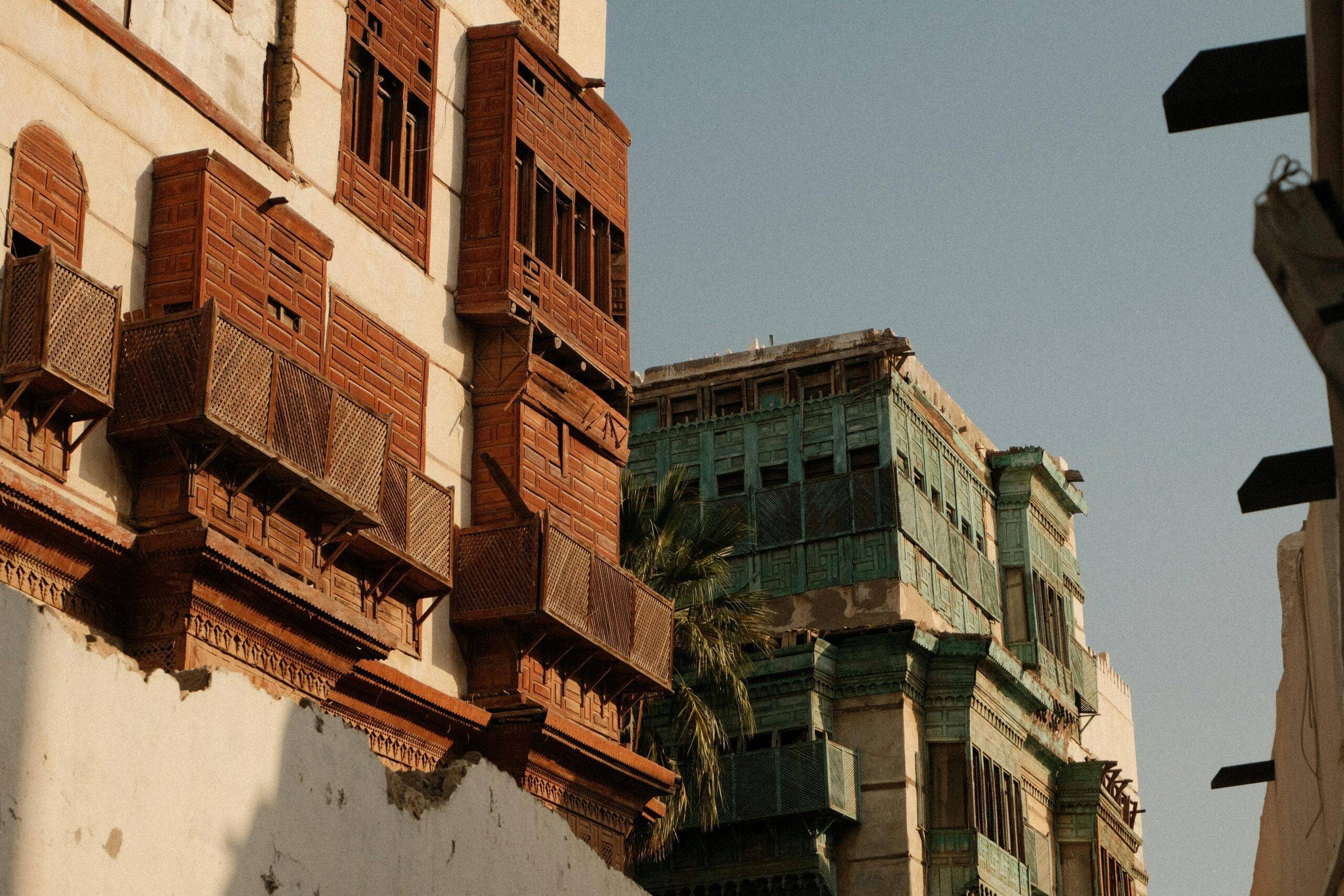
Spend the morning in Al-Balad (UNESCO), Jeddah's historic core. The coral-stone tower houses—some dating to the 16th century—feature carved wooden rawasheen (projecting bay windows) designed to catch coastal breezes. Streets here are narrow and walkable. Stop at Naseef House, a restored merchant residence now functioning as a cultural centre. In the late afternoon, explore the fish market at Bab Makkah and the surrounding wholesale produce area—Jeddah's commercial pulse, not a tourist attraction.
Dinner in the Hera Street area or Al-Balad's restored restaurants. Evening foot traffic peaks after 10pm; Jeddah is a night city.
Day 14 – The Corniche and Departure
Morning option: boat trip from Jeddah Yacht Club or Obhur Creek for snorkelling—reefs are accessible within 30 minutes. The Red Sea here is clear, uncrowded, and significantly less developed than comparable destinations in Egypt or Jordan. Alternatively, walk the Corniche sculptures, an open-air collection commissioned in the 1970s–80s featuring works by Miro, Henry Moore, and regional artists.
Final meal suggestion: fresh fish at one of the traditional seafood restaurants near the old harbour. Depart from King Abdulaziz International Airport (JED)—international terminal is 30 minutes from Al-Balad by car.
The Perspective
Fourteen days is not enough to understand Saudi Arabia. It is, however, enough to grasp its structure: a central plateau anchored by Riyadh, where the modern state took shape; an eastern corridor of oases that sustained trade for millennia; a northwestern archaeological belt where successive civilisations left their marks in stone; a highland region that developed its own architecture, climate, and traditions; and a Red Sea coast that has connected the peninsula to the wider world for centuries.
This itinerary does not attempt to show everything. It shows what matters for a first encounter: the relationship between landscape and culture, the layers of history that predate Islam and the transformations that followed, the contrast between the speed of current development and the patience required to appreciate what came before. By the time you reach Jeddah, you will have seen enough to understand why the country resists easy summary—and enough to know where to return.
The Grand Tour is a framework. What you build from it depends on what you notice along the way.
Summary Itinerary Table
| Days | Region | Theme | Transport |
|---|---|---|---|
| 1–3 | Riyadh | Origins and Modernity | Metro / Uber |
| 4–5 | Al-Ahsa | Oasis and Tradition | Car / Short Flight |
| 6–8 | AlUla | Archaeology and Art | Flight / Guided Tours |
| 9–10 | Tabuk | Wilderness and Discovery | 4x4 Required |
| 11–12 | Abha | Mountains and Heritage | Internal Flight |
| 13–14 | Jeddah | Red Sea and Farewell | Walking / Boat |
Related Reading
Plan Your Saudi Adventure
Ready to experience the Kingdom? Our AI-powered Trip Planner creates personalized itineraries based on your interests, budget, and travel dates. From Riyadh's skyline to AlUla's ancient tombs — let us help you discover Saudi Arabia your way.
Frequently Asked Questions
- How many days should I spend in Riyadh during a two-week Saudi Arabia trip?
- A two-week itinerary typically dedicates 3-4 days to Riyadh to explore the Kingdom Centre, Al Masmak Fortress, and the National Museum. This allows time for acclimatization and experiencing the capitals modern attractions before heading to other regions.
- What is the best time to visit Saudi Arabia for a two-week tour?
- November to March offers the most comfortable temperatures (15-25C), making it ideal for a comprehensive two-week tour covering multiple regions. Summer temperatures exceed 45C and are challenging for extended travel.
- Can I visit both Makkah and Medina as a non-Muslim tourist in Saudi Arabia?
- Non-Muslims cannot enter Makkah or the sacred areas of Medina, but the two-week itinerary focuses on visiting Medinas outer districts and other UNESCO sites like Al Ula and Diriyah. Muslim travelers can include Hajj or Umrah.
- How many flights or transfers will I need for a two-week grand tour of Saudi Arabia?
- A comprehensive two-week itinerary typically involves 3-4 domestic flights plus ground transportation. Plan 4-5 hours for each destination to maximize exploration time.