The 2027 Total Solar Eclipse in Saudi Arabia: Where to Stand on 2 August
Six minutes of totality cross western Saudi Arabia on 2 Aug 2027. Which cities are really in the path, and why coast and highlands are different bets.
Das Wichtigste in Kürze
- On 2 August 2027, the Moon's shadow crosses western Saudi Arabia in a 259 km-wide corridor — the Kingdom's first total solar eclipse in more than 75 years.
- Jeddah gets close to six minutes of totality with the easiest logistics; the Asir highlands around Khamis Mushait and Abha get slightly longer darkness but a higher chance of cloud.
- Taif sits near the edge of the path and gets only about 3 minutes 41 seconds — much less than Jeddah's roughly 5 minutes 53 seconds, despite the two being close together.
- Makkah lies in the path but is closed to non-Muslims; Jeddah is the practical alternative, 80 km away in the same corridor with more totality, not less.
- Book accommodation early — eclipse travellers plan years ahead and the Asir region has far fewer rooms than Jeddah.
On 2 August 2027 the Moon's shadow crosses western Saudi Arabia in a corridor about 259 km wide, running from the Red Sea coast down to the Najran region. Jeddah gets close to six minutes of totality and has the airport and the hotels. The Asir highlands get slightly longer totality and cooler air, but a higher chance of cloud. Makkah is inside the path and closed to non-Muslims. Everywhere else in the Kingdom sees a partial eclipse only.
Where you can stand, in one table
| If you want… | Go to | Totality | The trade-off |
|---|---|---|---|
| The simplest logistics | Jeddah / Red Sea coast | ~5 min 53 s | Hot and humid in August; dustiest stretch of the whole eclipse track |
| The longest darkness | Khamis Mushait / Abha (Asir) | ~6 min | Mountain cloud can build in the afternoon; fewer beds, longer transfers |
| Mountain air near Makkah | Taif | ~3 min 41 s | Near the northern edge of the path — you lose over two minutes |
| A pilgrimage context | Makkah | ~5 min 10 s | Closed to non-Muslims — the whole city, not only the Grand Mosque |
Duration figures for Jeddah, Khamis Mushait, Taif and Abha follow secondary sources — a city table based on timeanddate.com calculations, and press coverage of the Saudi Space Agency's announcement. The NASA centre-line table below is the primary source for the shadow's path and width.
What actually happens that afternoon
The eclipse of 2 August 2027 is one of the long ones. NASA's path data puts greatest eclipse at 10:06:37.7 UT over southern Egypt, with 6 minutes 22.6 seconds of totality on the centre line and a shadow 257.7 km wide. Fred Espenak's independent calculation on EclipseWise gives a greatest duration of 6 minutes 23.24 seconds. Eclipses this long are rare: the Moon is near perigee and the Earth near aphelion at the same time, so the shadow is both large and slow.
By the time the shadow reaches Saudi Arabia it has lost only a few seconds. Here is the centre line as NASA publishes it, converted to Arabia Standard Time (AST = UT + 3):
| Local time (AST) | Centre line | Path width | Duration on the centre line |
|---|---|---|---|
| 13:16 | 23° 26.2′ N, 36° 07.6′ E | 258 km | 6 min 19.6 s |
| 13:22 | 22° 02.6′ N, 37° 57.5′ E | 259 km | 6 min 16.3 s |
| 13:26 | 21° 05.1′ N, 39° 10.0′ E | 259 km | 6 min 13.6 s |
| 13:30 | 20° 06.1′ N, 40° 22.2′ E | 259 km | 6 min 10.5 s |
| 13:34 | 19° 05.7′ N, 41° 34.3′ E | 259 km | 6 min 06.9 s |
| 13:40 | 17° 32.0′ N, 43° 23.0′ E | 259 km | 6 min 00.8 s |
Source: NASA GSFC path table for the total solar eclipse of 2 August 2027, retrieved 7 September 2026. Times converted from UT to AST.
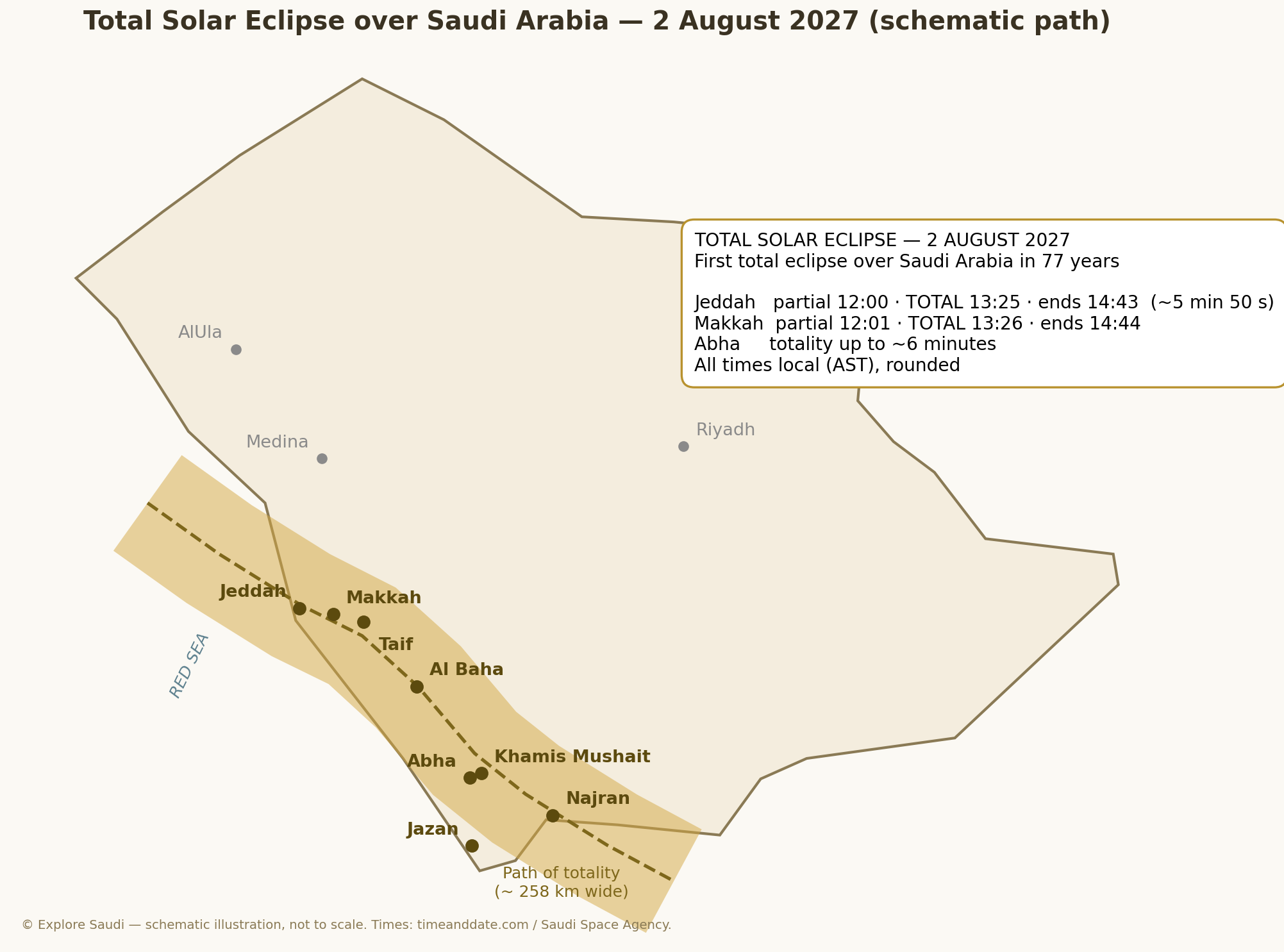
Two things follow from that table, and they matter more than any single city's headline number.
The shadow enters over water and leaves over mountains. The 13:26 row sits roughly 45 km south of Jeddah, out over the Red Sea approaches; the 13:34 row is already in the Asir foothills. The coastal plain between them is comfortably inside the corridor.
The edge is closer than people assume. The corridor is 259 km wide, so the centre line has about 130 km of margin either side. Taif, at roughly 100 km from the centre line, is inside it — but near enough to the boundary that its totality is a little over half of Jeddah's. That distinction is the most useful thing on this page: being in the path and being in a good place in the path are not the same decision.
Which Saudi cities are actually in the path
The Saudi Space Agency names Makkah, Jeddah, Taif, Al Baha, Khamis Mushait, Jazan and Najran. Abha and Al Qunfudhah also fall inside the corridor when checked against the NASA centre line — Al Qunfudhah sits barely 50 km off it, which makes the coast south of Jeddah one of the strongest positions in the country on paper.
Outside the corridor there is no darkness, only a deep bite out of the Sun. The Saudi Space Agency puts obscuration in the central, eastern and northern regions at up to 80 per cent. That sounds like a lot and looks like almost nothing: at 80 per cent obscuration there is still enough light to read by. Riyadh, Dammam, AlUla and Tabuk are all in that category. Travellers in the Kingdom that week who want the real thing have to move west.
Coast or highlands: the honest comparison
This is where the decision actually gets made, and the answer is not the same for everyone.
The Red Sea coast — Jeddah, Al Lith, Al Qunfudhah — is the low-risk choice for cloud. Jay Anderson's climatology for this eclipse shows the Tihamah plain running an August average cloud cover of just over 10 per cent; the mountains a few dozen kilometres inland do not reach it. That is about as close to a guarantee as eclipse weather gets.
The catch is dust. Anderson is blunt: the Tihamah plain has by far the highest average aerosol optical depth anywhere along the 2027 track, and the stretch south of Jeddah stands out particularly. Dust does not stop totality — a high dust pall makes for a dimmer but perfectly successful view — but it flattens the corona and the photographs. It is also forecastable a few days out, which matters if the last day can stay mobile.
The other catch is heat. August on the Jeddah coast is the hardest month of the year: humidity on top of temperature, with no relief in the middle of the day. Totality falls in the early afternoon. Plan shade, water and an arrival hours early rather than minutes.
The Asir highlands — Abha, Khamis Mushait — buy the longest totality in the Kingdom and a genuinely different climate. The plateau sits well above 2,000 m and August afternoons there are mild rather than punishing. The trade is cloud: Anderson's numbers put most Saudi sites away from the coastal strip at sunshine percentages down in the 60s, and the Asir range is exactly where afternoon build-up happens. In practice that is a forecast call made two or three days out, not a booking call made two years out.
Anderson's overall verdict is worth carrying either way: cloud cover along this track is among the lowest he has analysed in 45 years of doing this work. Both options are good. They are good in different ways.
Makkah: the part that has to be said plainly
Makkah lies inside the path of totality and gets roughly 5 minutes 10 seconds. It is also closed to non-Muslims — the restriction covers the entire city, not only the Grand Mosque, and checkpoints on the approach roads enforce it. There is no visitor workaround and it is not a question of dress or discretion.
For Muslim travellers this is an extraordinary conjunction and worth planning around early. For everyone else the practical answer is Jeddah: 80 km away, in the same corridor, and with more totality than Makkah, not less. Taif is the other near option, and it costs over two minutes.
Getting there and staying
Jeddah's King Abdulaziz International is the obvious entry point for the coastal option; Abha has its own airport with domestic connections for the highland one. Check the current entry rules in our Saudi visa guide before booking anything — those rules have changed repeatedly and we keep that page as the single source rather than repeating numbers here.
For where to sleep, our hotel guide covers Jeddah in depth; the Taif guide and the Abha and Asir pages cover the inland options. Eclipse demand behaves unlike ordinary travel demand: it concentrates on one night in a narrow band of towns, and the towns in the Asir corridor have far fewer rooms than Jeddah does. If the highlands are the plan, accommodation is the binding constraint, not the flight.
The days either side are worth building out. Jeddah's Al-Balad is a UNESCO-listed old town twenty minutes from the airport; the Asir mountain route and the Taif rose country sit inside or beside the path. Our itineraries can carry the rest of the trip.
Watching it safely
The rule is simple and there is no version of it that bends. During every partial phase — more than two hours of that afternoon — certified eclipse glasses to ISO 12312-2 are required, or a proper solar filter on any telescope or camera. Sunglasses, exposed film, welding glass below shade 14 and smoked glass are all unsafe. Only during totality itself, when the Sun's disc is completely covered, is the naked eye safe, and the filter goes back on the moment the first bright bead of the photosphere returns.
Buy from a supplier that names the standard and the manufacturer. Counterfeits with an ISO number printed on them circulate before every major eclipse.
Anyone planning to photograph it needs a solar filter on the lens during the partial phases as much as on their eyes — and the most common regret people report afterwards is having spent the six minutes behind a viewfinder. Set the camera up, then look.
What to do now, and when
- Now (2026): decide coast or highlands. That decision drives everything else, and it is a weather-risk decision, not a sightseeing one.
- Late 2026: book accommodation. Eclipse travellers book years out and the Asir inventory is thin.
- Spring 2027: book flights. Buy eclipse glasses from a named, reputable supplier — not in the final week.
- Late July 2027: watch the cloud and dust forecasts. Keep the last 48 hours mobile if possible; inside a 259 km corridor there is real room to drive away from a cloud deck.
- 2 August 2027: be in position hours early. Totality falls in the early afternoon heat.
Also in the Saudi 2027 calendar: the Dakar Rally, 1–15 January.
Häufig gestellte Fragen
- When is the total solar eclipse in Saudi Arabia?
- 2 August 2027. The shadow crosses the Kingdom between about 13:16 and 13:40 Arabia Standard Time, with more than two hours of partial phases around it.
- Which cities are in the path of totality?
- The Saudi Space Agency names Makkah, Jeddah, Taif, Al Baha, Khamis Mushait, Jazan and Najran. Abha and Al Qunfudhah also fall inside the corridor. Everywhere else in the Kingdom, including Riyadh, Dammam, AlUla and Tabuk, sees a partial eclipse only.
- How long will totality last?
- Around six minutes on the centre line as it crosses the Kingdom — NASA's path data gives 6 min 19.6 s where the shadow enters Saudi territory and 6 min 00.8 s where it leaves towards Yemen. Individual cities get less depending on how far they sit from that line: secondary sources (a city table based on timeanddate.com calculations, and press coverage of the Saudi Space Agency's announcement) put Jeddah at roughly 5 min 53 s, Makkah at 5 min 10 s, Khamis Mushait at about six minutes, and Taif at about 3 min 41 s.
- Why does Taif get so much less than Jeddah?
- Because it is near the edge of the corridor. The path is about 259 km wide, and the closer you are to its northern or southern boundary, the shorter the shadow's crossing. Taif sits roughly 100 km off the centre line; Jeddah is much closer to it.
- Can non-Muslims watch the eclipse in Makkah?
- No. Makkah is closed to non-Muslims — the entire city, not only the Grand Mosque. Jeddah lies in the same corridor 80 km away, is open to all travellers, and gets a longer totality than Makkah.
- Is the coast or are the mountains the better bet for clear skies?
- The coast, on the averages. August cloud cover on the Tihamah plain runs just over 10 per cent; most inland Saudi sites in the path run sunshine percentages in the 60s, and the Asir range is where afternoon cloud builds. The coast's own weakness is dust — it carries the highest aerosol load anywhere on this eclipse track.
- Do I need special glasses?
- Yes, for every minute of the partial phases: certified eclipse glasses to ISO 12312-2, or a proper solar filter on any telescope or camera. Only during totality itself is the naked eye safe.
- Will the rest of Saudi Arabia see anything?
- Yes — a deep partial eclipse, with obscuration reaching up to 80 per cent in the central, eastern and northern regions according to the Saudi Space Agency. It is worth stepping outside for. It is not darkness, and it is not what people travel for.