Ancient AlUla Guide: Exploring Saudi Arabia’s Hidden Wonder
Hegra's 111 Nabataean tombs can only be seen on a guided tour, from SAR 95. What to see at Dadan, Jabal Ikmah and Old Town, and when to book.
Key Takeaways
- Hegra holds 111 monumental Nabataean tombs and can be visited on a guided tour only - tours start from SAR 95 per person, run about two hours, and are booked through experiencealula.com.
- Qasr al-Farid, the Tomb of Lihyan son of Kuza, stands about 22 m high and was never finished; the unfinished lower section shows how Nabataean tombs were carved from the top down.
- Jabal Ikmah's canyon walls carry hundreds of Dadanitic, Thamudic, Minaic and Aramaic inscriptions and were added to the UNESCO Memory of the World register in 2023.
- The Saudi tourist eVisa covers 66 nationalities and costs SAR 535 (SAR 395 visa plus SAR 140 mandatory insurance), valid one year for multiple entries of up to 90 days each.
- October to early April is the workable season, with daytime temperatures of 15-25 C; June to August regularly exceeds 40 C and outdoor sites compress to early-morning schedules.
- Sites are 10-25 km apart with no public transport - either rent a car at ULH airport or use the free Experience AlUla shuttle between the Old Town, hotels and heritage sites.
What AlUla actually is
AlUla is an oasis valley in the north-west of Saudi Arabia, in the Medina Region, roughly 300 km inland from the Red Sea. It sits on the old incense route that carried frankincense and myrrh from southern Arabia to the Mediterranean, and successive kingdoms built here because the valley had water and the route had traffic. What survives is unusually layered: Dadanite and Lihyanite remains from the first millennium BCE, a Nabataean city from around the turn of the era, an Islamic-era mud-brick town occupied until the 1980s, and rock inscriptions spanning thousands of years in between.
Since 2019 the Royal Commission for AlUla has run the valley as a single managed destination. In practice that means most archaeological sites are ticketed, several are accessible only with a guide, and almost everything is booked through one platform rather than at the gate. Planning ahead is not optional here in the way it is at most destinations. A wider look at the region is in our AlUla destination page.
Getting there and getting around
AlUla International Airport (ULH) is 35 km south-east of the town centre and takes domestic flights from Riyadh and Jeddah, with the route network expanding in winter and thinning out in summer. Check current schedules rather than assuming a connection exists in your month. From Riyadh the flight is a little under two hours; from Jeddah about 1 hour 20 minutes.
Distances inside the valley run from 10 to 25 km between the main sites, and there is no ordinary public transport. Two options work: rent a car at the airport, which gives you the freedom to be at Elephant Rock at sunset and Hegra at opening, or use the free Experience AlUla shuttle, which loops between the Old Town, the main hotel cluster and the heritage sites on a fixed timetable. The shuttle is fine if you are staying two nights and doing the standard circuit; a car pays for itself if you want the outlying viewpoints.
Heritage site tickets are sold through experiencealula.com and daily capacity is capped. Between October and March, book at least two weeks out; over public holidays and festival weekends, longer.
Hegra: the Nabataean city
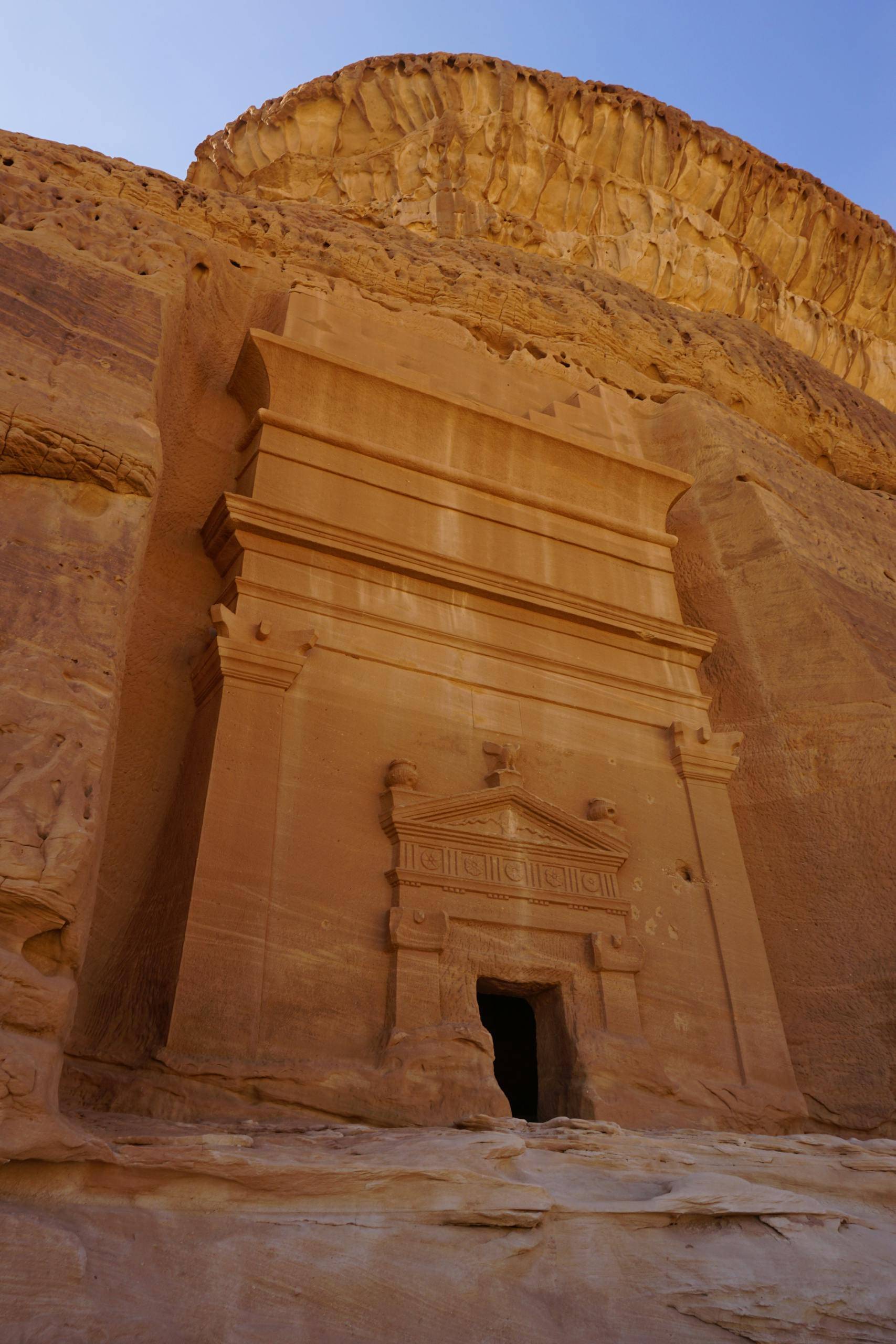
Hegra, also called Mada'in Salih or Al-Hijr, became Saudi Arabia's first UNESCO World Heritage Site in 2008. It was the southern city of the Nabataean kingdom, the same civilisation that carved Petra some 500 km to the north, and it was in use roughly from the 1st century BCE to the 1st century CE. There are 111 monumental tombs cut into sandstone outcrops scattered across open desert, most of them decorated with eagles, sphinxes, urns and stepped crenellations, and many carry inscriptions naming the owner and the penalty for reuse.
The single most photographed structure is the Tomb of Lihyan son of Kuza, known as Qasr al-Farid, the “lonely castle”. It stands alone on its own outcrop, around 22 m high, and was never finished — the chisel marks stop partway down, which is precisely what makes it useful: you can read the construction sequence, top to bottom, in a single facade.
Access is by guided tour only. Tours start from SAR 95 per person and run about two hours, either on a coach or in a private 4x4, stopping at Jabal Ithlib, Jabal Banat, Jabal Ahmar and the Lihyan tomb. There are also vintage Land Rover tours at a higher price. Morning departures are cooler, and the east-facing tomb facades take the light better before midday.
Dadan and Jabal Ikmah
Dadan was the capital of the Dadanite and later Lihyanite kingdoms, several centuries before the Nabataeans arrived, and it controlled the same trade route. The site is built against the red cliff face, and the feature people come for is the row of tombs cut high into the rock with carved lions flanking the entrances — burials for the elite, positioned where the whole valley could see them.
A few minutes away, Jabal Ikmah is a narrow canyon whose walls carry hundreds of inscriptions in Dadanitic, Thamudic, Minaic and Aramaic. They record dedications, laws, names and rituals, and the collection was added to the UNESCO Memory of the World register in 2023. An hour is enough. It is the quietest of the major sites and the one that most changes how you read the rest of the valley: this was a literate place with a functioning administration long before the tombs at Hegra were cut.
Dadan and Jabal Ikmah are usually sold together as a single guided tour. Like Hegra, they are not walk-in sites.
AlUla Old Town
The Old Town is a dense stack of roughly 900 mud-brick houses built against the base of the escarpment, continuously inhabited until residents moved to modern housing in the 1980s. A restored lane now runs through the middle with cafes, craft workshops and coffee roasters; the unrestored quarter behind it is open to walk and gives a much better sense of how the town worked, with shared walls, narrow shaded alleys and a single defensible entrance.
Musa bin Nusayr Castle sits on the outcrop above and is a short, steep climb for the best view over the palm groves and the valley. Late afternoon is the time to go, both for the light and because the mud brick radiates heat until then.
Elephant Rock and the wider landscape
Jabal AlFil, Elephant Rock, is a wind-eroded sandstone monolith about 11 km north-east of town that reads unmistakably as an elephant with its trunk to the ground. The sand around it has been sunk into seating areas with fire pits and there is a drinks kiosk. It is busy at sunset and still worth timing for that.
Beyond it, the Gharameel rock field is where stargazing tours run: a scatter of thin sandstone pinnacles in open desert well away from town lights. AlUla has very little light pollution and the winter sky is genuinely dark, which is why the observatory programme and the guided night tours are based out there rather than in the valley. Harrat Uwayrid, the volcanic plateau on the western rim, gives an overhead view of the whole oasis and is reachable by road.
Maraya, the mirrored concert hall in the Ashar valley, is not an archaeological site but it is worth knowing about: it holds a Guinness World Record as the largest mirrored building, and event programming there drives hotel prices across the valley for those dates.
Where to stay
Accommodation splits into three bands. The resorts in the Ashar and Ashaikhah valleys are the expensive end and the reason AlUla has a reputation as a costly stop; they book out months ahead for the winter season. The Old Town has a small number of heritage conversions inside the mud-brick fabric itself. And there are straightforward hotels and guesthouses in and around the modern town at a fraction of resort rates.
Whichever band you are in, accommodation is the largest single cost of an AlUla trip and the one that moves most with timing. Book it before you book anything else. Our AlUla hotels and resorts guide sets out what is currently bookable in each band, and the broader hotel guide covers the rest of the country.
Entry requirements
Citizens of 66 countries can apply for the Saudi tourist eVisa online at visa.visitsaudi.com. The fee is SAR 535, made up of SAR 395 for the visa and SAR 140 of mandatory medical insurance. It is valid for one year, allows multiple entries of up to 90 days each, and most applications are decided within 24 to 72 hours. Apply with time in hand rather than the night before.
Holders of a used tourist or business visa from the US, UK or Schengen area, and residents of those areas, may instead be eligible for a visa on arrival at the major international airports, issued at a lower fee. The eligibility rules are narrower than they look and are set out in our visa on arrival guide. Your passport needs at least six months of remaining validity either way.
When to go, and what that changes
October to early April is the window. Daytime temperatures in that period typically sit between 15 °C and 25 °C, which is what open-air archaeology requires. Evenings from November to March drop to roughly 8–15 °C, so a warm layer is needed for anything after dark — Elephant Rock, a Gharameel stargazing tour, dinner outdoors.
June to August regularly exceeds 40 °C and the shade at these sites is minimal. Tours still run but schedules compress into the early morning, and the experience is materially worse. October and April are the useful shoulder months: fewer visitors, warmer days, the same clear skies.
If your dates fall in Ramadan, restaurant hours shift substantially and daytime service is limited; a hotel with half-board removes the problem. For a day-by-day version of a short visit, see our three-day AlUla itinerary.
What to pack
Long-sleeved UV-protective clothing rather than plain cotton, closed shoes with grip because loose sandstone at Hegra and Dadan is slippery underfoot, at least two litres of water per person per day, and a power bank — there is no charging at Jabal Ikmah or Gharameel. Binoculars are more useful here than at most sites: much of the detail at Hegra, including the eagle carvings, sits high on the facades and is hard to read from the ground.
Rules that matter on site
Do not touch carvings or inscriptions; skin oils degrade the sandstone, and staying behind the barriers is enforced. Drone use is regulated and requires a permit from the General Authority of Civil Aviation, which you need to arrange before you travel — heritage sites are not somewhere to test whether the rule is applied. Commercial and professional photography needs advance approval from the Royal Commission; ordinary visitor photography does not.
On dress, shoulders and knees covered is the expectation for everyone. Women have not been required to wear an abaya or headscarf since 2019, and lightweight long layers are the practical choice in this climate anyway.
The dry air is the thing people underestimate. It removes sweat before you notice it, so thirst arrives late. Carry more water than feels necessary, and treat the summer midday closures at outdoor sites as information rather than an inconvenience.
Fitting AlUla into a longer route
Two nights covers Hegra, Dadan, Jabal Ikmah and the Old Town without rushing, which makes AlUla a natural middle leg between Riyadh and Jeddah. Put your dates into the Trip Planner to see how that sequences with flights, and check what is bookable in the valley for your week in our hotel guide.
Frequently Asked Questions
- Can I visit Hegra on my own?
- No. Hegra is accessible by guided tour only, on a coach or in a private 4x4, with daily capacity capped. Tours start from SAR 95 per person and last about two hours. Book on experiencealula.com at least two weeks ahead for travel between October and March.
- How many tombs are there at Hegra?
- 111 monumental tombs, cut into sandstone outcrops across an open desert plain and dating roughly from the 1st century BCE to the 1st century CE. Many carry inscriptions naming the owner and the penalty for reusing the tomb.
- What visa do I need for AlUla?
- The Saudi tourist eVisa, available online at visa.visitsaudi.com to citizens of 66 countries. It costs SAR 535 - SAR 395 for the visa plus SAR 140 of mandatory medical insurance - and is valid one year for multiple entries of up to 90 days each, capped at 180 days per year. Most applications are decided in 24 to 72 hours.
- When is the best time to visit AlUla?
- October to early April, when daytime temperatures sit between 15 C and 25 C. Evenings from November to March fall to roughly 8-15 C, so bring a warm layer for stargazing or Elephant Rock after dark. June to August regularly exceeds 40 C and most outdoor touring shifts to the first hours after sunrise.
- How many days does AlUla need?
- Two full days covers Hegra, Dadan, Jabal Ikmah and the Old Town at a reasonable pace. A third day adds Gharameel stargazing, the Harrat Uwayrid overlook or a hike in Sharaan Nature Reserve.
- Can I fly a drone at the heritage sites?
- Not without a permit. Drone use in Saudi Arabia is regulated by the General Authority of Civil Aviation and approval must be arranged before you travel. Commercial and professional photography also requires advance approval from the Royal Commission for AlUla; ordinary visitor photography does not.