Dakar Rally 2027 in Saudi Arabia: The Full Route and How to Follow It

All 14 stages of the 2027 Dakar, 1–15 January: start/finish towns, 5,320 km of specials, and where spectators can actually get close.
Das Wichtigste in Kürze
- The 2027 Dakar runs 1-15 January as a loop starting and finishing at King Abdullah Economic City (KAEC), with a record 5,320 km of timed special stages.
- The route splits into three blocks: a northern week through Yanbu, AlUla and Hail, a southern week around Bisha and Wadi Ad-Dawasir, and a return leg over Al Bahah to the coast.
- The two easiest spectator moments are the start and finish at KAEC; stage starts and finishes in towns like AlUla, Hail and Bisha are the realistic in-between option.
- AlUla, reached by the rally on 3 January, is the strongest overlap between the Dakar and normal sightseeing.
- Partner PURE Saudi by DISCOVERY runs guided fan tours of 9 to 17 days, including bivouac access and the opening ceremony at KAEC - details and prices come directly from DISCOVERY.
The 2027 Dakar runs 1–15 January, a loop starting and finishing at King Abdullah Economic City north of Jeddah, with a record 5,320 km against the clock. Visitors who want to see it without organising a desert expedition themselves have two accessible fixed points: the start at KAEC on 1–2 January and the finish there on 15 January. Everything in between moves 500 to 900 km a day.

The 2027 route, stage by stage
A.S.O. published the route in May 2026. This is the official schedule:
| Stage | Date | From → To | Total | Special |
|---|---|---|---|---|
| Prologue | Fri 1 Jan | KAEC → KAEC | 265 km | 30 km |
| 1 | Sat 2 Jan | KAEC → Yanbu | 500 km | 350 km |
| 2 | Sun 3 Jan | Yanbu → AlUla | 535 km | 310 km |
| 3 | Mon 4 Jan | AlUla → Hail | 745 km | 480 km |
| 4 | Tue 5 Jan | Hail → Hail | 735 km | 380 km |
| 5 | Wed 6 Jan | Hail → Al Duwadimi | 720 km | 480 km |
| 6 | Thu 7 Jan | Al Duwadimi → Marathon Refuge | 565 km | 440 km |
| 7 | Fri 8 Jan | Marathon Refuge → Bisha | 480 km | 430 km |
| — | Sat 9 Jan | Rest day, Bisha | — | — |
| 8 | Sun 10 Jan | Bisha → Bisha | 680 km | 460 km |
| 9 | Mon 11 Jan | Bisha → Wadi Ad-Dawasir | 730 km | 460 km |
| 10 | Tue 12 Jan | Wadi Ad-Dawasir → Bisha | 650 km | 515 km |
| 11 | Wed 13 Jan | Bisha → Al Bahah (marathon) | 630 km | 480 km |
| 12 | Thu 14 Jan | Al Bahah → KAEC | 905 km | 455 km |
| 13 | Fri 15 Jan | KAEC → KAEC | 250 km | 50 km |
| Total | 8,390 km | 5,320 km |
Source: dakar.com official route page, retrieved 7 September 2026. Distances are as published and are routinely adjusted before the start; check dakar.com in December for the final road book.
The 5,320 km of timed specials is the headline. A.S.O. describes it as more special mileage than any previous Saudi edition; the previous high was 4,903 km in 2025. Stage 10 out of Wadi Ad-Dawasir, at 515 km against the clock, is the single longest.
Two endurance features are built in. Stage 6 finishes at a bare "Marathon Refuge" bivouac, and stages 11 and 12 form a conventional marathon leg through Al Bahah — in both cases crews spend the night without their full service teams. That is where the rally is usually decided.
What the route means if you are following it
Read the table as a travel problem rather than a race schedule and three things jump out.
It is a genuine loop, and it is huge. 8,390 km of total distance in fifteen days means the caravan averages well over 500 km a day, and stage 12 alone is 905 km. Following the whole thing by road is a full-time driving job, not a holiday.
It splits cleanly into three blocks. The first week runs north — KAEC, Yanbu, AlUla, Hail — the part of Saudi Arabia most travellers already want to see. The middle week works the south around Bisha and Wadi Ad-Dawasir, on the northern approaches to the Empty Quarter, remote country with thin tourist infrastructure. The last two days come back over Al Bahah to the coast.
Bisha is the hinge. The rest day on 9 January is there, and stages 7, 8, 10 and 11 all start or finish there. Anyone picking one base for the middle of the rally should pick that one — and it is also where accommodation will be hardest to find.
Where spectators can actually get close
The honest answer is: less often than the television coverage suggests, and almost never in the middle of a special.
The start at KAEC (1–2 January) is the easiest access of the whole rally. Scrutineering and the start podium take place at a large bivouac near the city centre on the Red Sea; A.S.O. calls it the mustering point for the entire caravan. This is the day for seeing the cars, the trucks and the riders close up, and it needs no off-road capability at all. KAEC is about 100 km north of Jeddah on the coastal motorway.
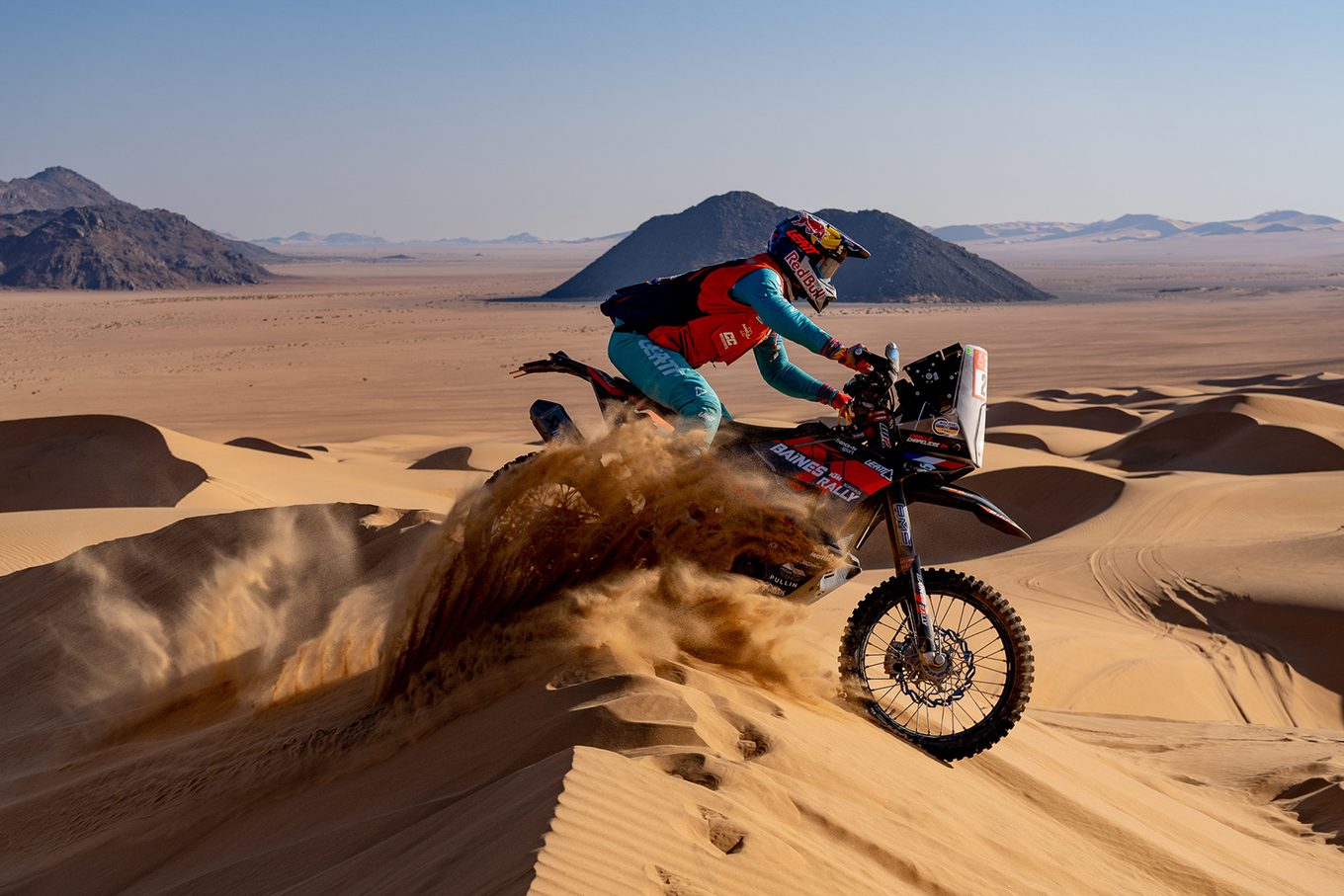
The finish at KAEC (15 January) is the other fixed public moment, with a short 50 km closing special and the podium.
Stage starts and finishes in the towns — Yanbu, AlUla, Hail, Bisha, Wadi Ad-Dawasir, Al Bahah — are the realistic in-between option. Competitors pass through a defined point at a published time and the town itself is reachable on tarmac. AlUla on 3 January is the strongest of these for a visitor who is also there to travel: the rally arrives in a place worth two days in its own right.
Points along a special stage need permits, a 4x4, navigation and the willingness to sit in the desert for hours. Spectator access along the route depends on the stage layout, which A.S.O. publishes closer to the race and can change on safety grounds. Building a trip around a specific dune viewpoint that has not been confirmed is not a safe bet.
The bivouac is not open to the public. Access runs through accreditation.
Travelling the route
January is the right month to be in Saudi Arabia, which is the one genuinely easy part of this trip: daytime temperatures in the rally regions are mild and the nights in the interior are properly cold — pack a warm layer, people consistently underestimate this.
Distances are the real constraint. Between the northern block and the southern block there is no short way round: Hail to Bisha is most of the length of the country. Most visitors following more than one or two stages fly domestically between the blocks rather than drive.
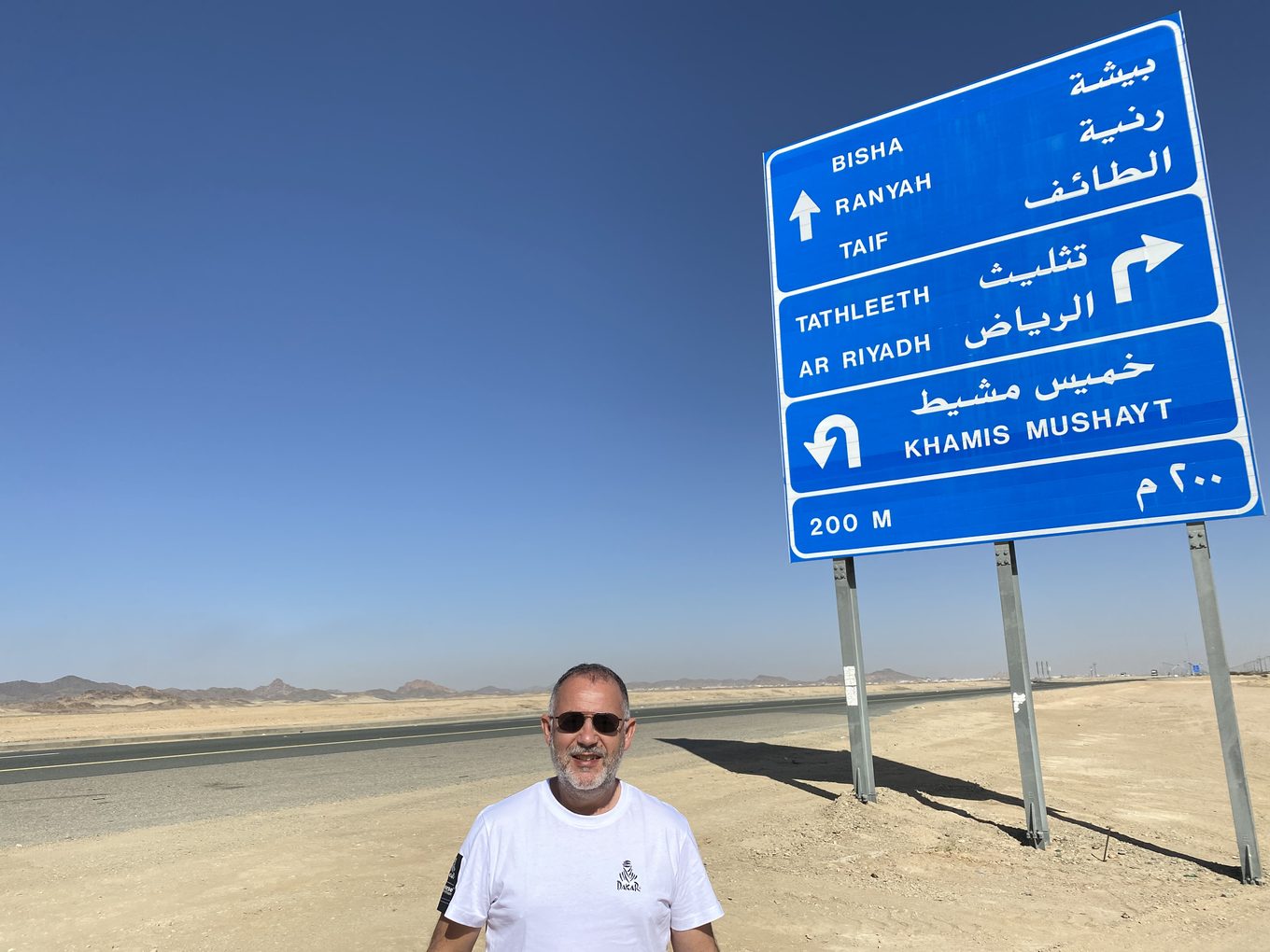
For the northern week, AlUla is the obvious base and our three-day AlUla guide fits neatly around the 3 January stage; where to stay in AlUla covers the accommodation, which books out early in January even without the Dakar. For the coastal start and finish, Jeddah is the practical base for KAEC. For the southern week around Bisha and Al Bahah, options are thin and the road distances are long — our Asir and Abha material is the closest coverage we have.
Check the current entry rules in our Saudi visa guide before booking, and see our itineraries for building the rest of the trip around the rally. For whether January is the right time for the rest of the country as well, our best time to visit guide has the seasonal picture.
Experience the Dakar with a guided fan tour
Following a rally that moves hundreds of kilometres a day takes logistics that are genuinely hard to arrange independently: vehicles, permits, bivouac access and route knowledge. Our partner PURE Saudi by DISCOVERY has been running guided Dakar fan tours in Saudi Arabia since 2020 — 2027 will be their eighth edition, and more than 360 Dakar fans have travelled with them so far.
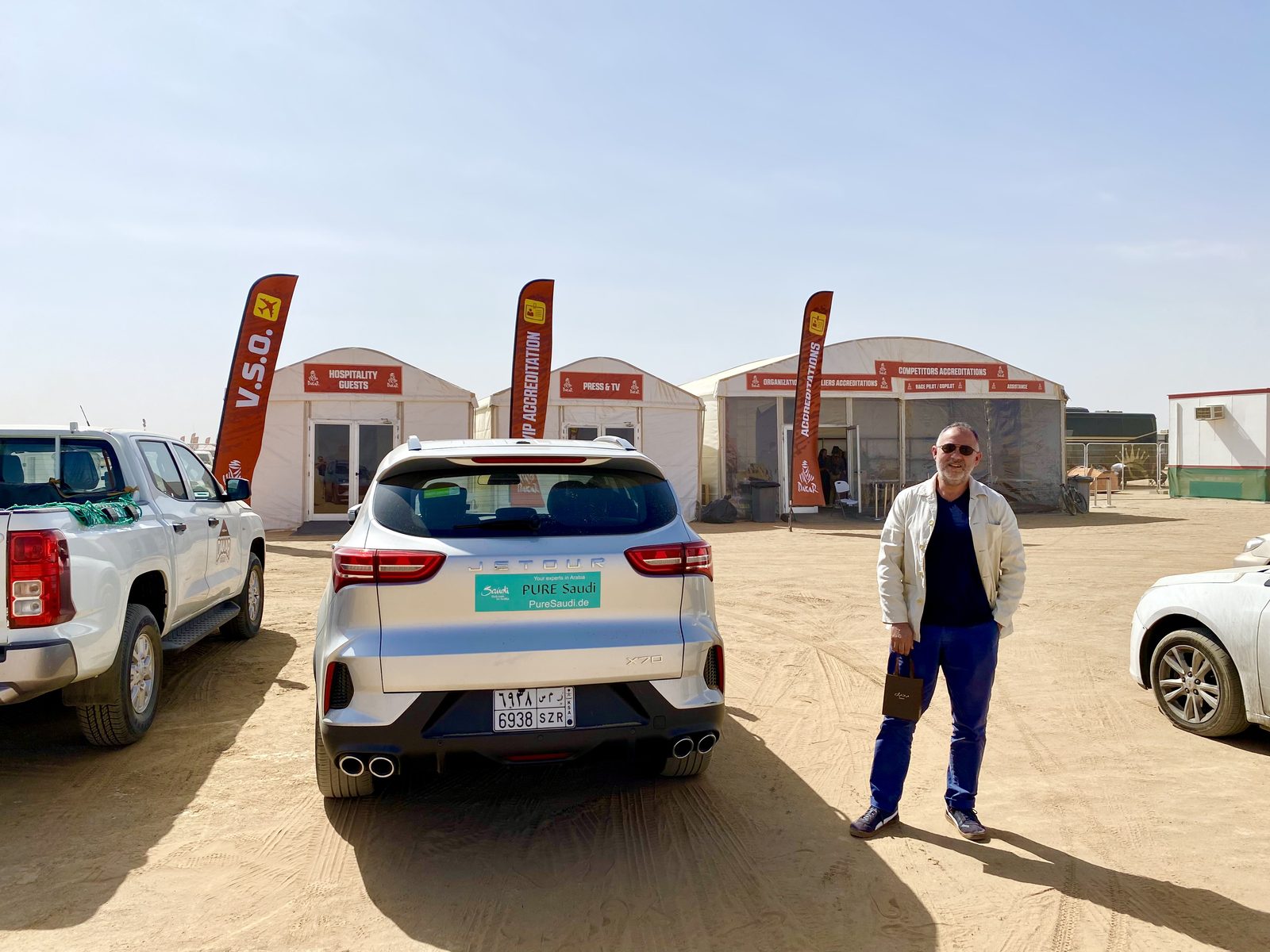
Their 2027 programme includes guaranteed departures from eight participants, tour lengths from 9 days/7 nights to 17 days/16 nights, travel in 4x4 off-road vehicles with a maximum of three guests per vehicle, an exclusive Dakar bivouac pass, access to the official opening ceremony at KAEC, accommodation in selected 3–4 star hotels with desert tents in AlUla, and a sightseeing programme at AlUla's UNESCO sites — accompanied throughout by a Dakar and motorsport expert. A flexible option lets travellers join and leave the tour in Jeddah, Hail, Riyadh or Medina. Details, dates and prices come directly from PURE Saudi by DISCOVERY.
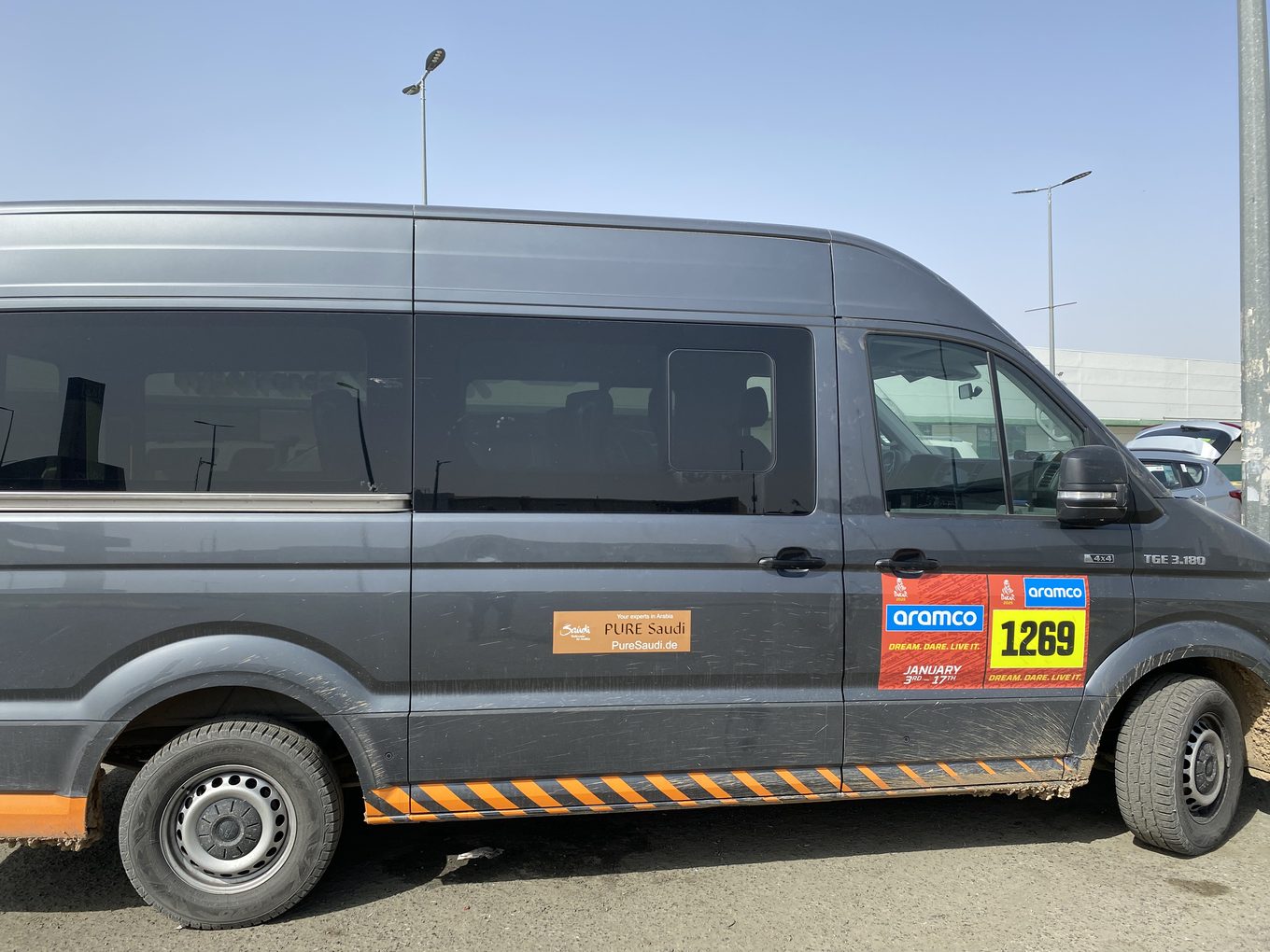
Transparency: PURE Saudi by DISCOVERY is a partner of Explore Saudi. We do not charge for this mention; details, prices and bookings are handled entirely by DISCOVERY. Photos on this page: DISCOVERY Events and Saudi Motorsport / Visit Saudi, used with permission.
Why the Dakar stays in Saudi Arabia
The rally moved here in 2020 and 2027 is the eighth consecutive edition. The reason is terrain: few countries offer this range of raceable ground inside one border — the sand seas of the interior, the volcanic harrat fields, the sandstone country of the northwest and long coastal runs on the Red Sea. A.S.O. has said the 2027 route carries a much higher proportion of sand than the 2026 edition did.
For a visitor, the side effect is that the rally works as a moving survey of regions most itineraries never reach. Al Duwadimi, Bisha and Wadi Ad-Dawasir are not on anyone's first trip. In January they are on television.
Also in Saudi Arabia in the 2027 calendar: the total solar eclipse of 2 August 2027, which crosses the west of the country.
Häufig gestellte Fragen
- When is the Dakar Rally 2027?
- 1 to 15 January 2027, starting and finishing at King Abdullah Economic City on the Red Sea coast north of Jeddah, with the rest day at Bisha on 9 January.
- How long is the 2027 Dakar?
- 8,390 km in total, of which 5,320 km are timed special stages — more special mileage than any previous Saudi edition, ahead of the 4,903 km of 2025. The longest single special is stage 10 at 515 km.
- Where can spectators watch the Dakar in Saudi Arabia?
- The opening ceremony and start podium at KAEC on 1–2 January and the finish there on 15 January are the two easily accessible moments. In between, stage starts and finishes in Yanbu, AlUla, Hail, Bisha, Wadi Ad-Dawasir and Al Bahah are reachable on tarmac. Access to points along the special stages depends on the layout published closer to the race, and the bivouac is accreditation-only.
- Which towns does the 2027 route pass through?
- KAEC, Yanbu, AlUla, Hail, Al Duwadimi, Bisha, Wadi Ad-Dawasir and Al Bahah, plus a bivouac refuge between Al Duwadimi and Bisha.
- Can I combine the Dakar with normal sightseeing?
- Yes, and the first week is built for it — the route runs Yanbu, AlUla and Hail, which is the classic northwest circuit. AlUla on 3 January is the single best overlap of rally and destination.
- Do I need a visa to visit Saudi Arabia for the Dakar?
- Most visitors can apply for the tourist eVisa online. Rules and fees change, so see our Saudi visa guide for the current position rather than relying on figures repeated elsewhere.
- What is the weather like during the Dakar in January?
- January is peak travel season in Saudi Arabia: mild in the daytime across the rally regions, and genuinely cold at night in the interior. Pack for both.